
Mafiree logo
  • About
  • Services
  • Blogs
  • Careers
  • Products
    • orbit logo Orbit
    • streamer logo Xstreami
  • Contact
Schedule a Call
Menu
  • About
  • Services
  • Blogs
  • Careers
  • Products
    • orbit logo Orbit
    • streamer logo Xstreami
  • Contact
  • Schedule a Call
Database
Database Managed Database Services
MySQL MySQL
MySQL Consulting
MySQL Migration Services
MySQL Optimization & Query Tuning
MySQL Database Administration
MySQL Backup & Recovery
MySQL Security & Maintenance
MySQL Cloud Services (AWS RDS, Aurora, Google Cloud SQL, Azure)
MySQL for Ecommerce
MySQL High Availability & Replication
MongoDB MongoDB
MongoDB Consulting
MongoDB Migration Services
MongoDB Optimization & Query Tuning
MongoDB Database Administration
MongoDB Backup & Recovery
MongoDB Security & Maintenance
MongoDB Cloud (Atlas)
MongoDB Solutions by Industry
MongoDB High Availability & Replication
PostgreSQL PostgreSQL
PostgreSQL Consulting
PostgreSQL Migration & Upgrades
Performance Tuning & Query Optimization
PostgreSQL Administration & Managed Services
High Availability, Clustering & Replication
PostgreSQL Backup, Recovery & Disaster Planning
PostgreSQL Security, Compliance & Auditing
PostgreSQL for Analytics & Data Warehousing
PostgreSQL on Cloud & Containers
PostgreSQL Extensions & Open-Source Integrations
PostgreSQL for Every Industry
SQL Server MSSQL
MSSQL Consulting
MSSQL Migration Services
MSSQL Optimization & Query Tuning Services
MSSQL Database Administration Services
MSSQL Backup & Recovery Services
MSSQL High Availability & Replication Services
MSSQL Security & Compliance Services
MSSQL Performance Monitoring & Health Checks
MSSQL Solutions by Industry
Aerospike Aerospike
Aerospike Consulting
Aerospike Migration Services
Aerospike Performance Optimization & Tuning
Aerospike Database Administration
Aerospike Backup & Recovery
Aerospike High Availability
Aerospike Cloud & Hybrid Deployments
Aerospike for Real-Time Applications (AdTech, FinTech, Retail, IoT)
Clickhouse Clickhouse
ClickHouse Consulting
ClickHouse Migration Services
ClickHouse Optimization & Query Tuning
ClickHouse Database Administration
ClickHouse Backup & Recovery
ClickHouse Security & Maintenance
ClickHouse Cloud Services (ClickHouse Cloud, AWS, GCP, Azure)
ClickHouse Solutions by Industry
ClickHouse High Availability & Replication
TiDB TiDB
TiDB Consulting
TiDB Administration & Maintenance
TiDB Security and Privacy Maintenance
TiDB Performance & Query Optimization
TiDB Migration Services
TiDB Backup & Disaster Recovery
TiDB High Availability Solutions
TiDB Solutions by Industry
TiDB Cloud Services
ScyllaDB ScyllaDB
ScyllaDB Consulting
ScyllaDB Administration & Maintenance
ScyllaDB Security and Privacy Maintenance
ScyllaDB Performance & Query Optimization
ScyllaDB Migration Services
ScyllaDB Backup & Disaster Recovery
ScyllaDB High Availability Solutions
ScyllaDB Solutions by Industry
ScyllaDB Cloud Services
DevOps
DevOps DevOps Services
Version Control Version Control
Kubernetes Kubernetes
Infrastructure Infrastructure Management
Web Servers Web Servers
Networking
Networking Networking Services
Basic Basic
Advanced Advanced
MySQL MySQL
MongoDB MongoDB
PostgreSQL PostgreSQL
MSSQL MSSQL
Aerospike Aerospike
Clickhouse Clickhouse
TiDB TiDB
ScyllaDB ScyllaDB
Version Control Version Control
Kubernetes Kubernetes
Infrastructure Infrastructure Management
Web Servers Web Servers
Basic Basic
Advanced Advanced
MySQL Consulting
MySQL Migration Services
MySQL Optimization & Query Tuning
MySQL Database Administration
MySQL Backup & Recovery
MySQL Security & Maintenance
MySQL Cloud Services (AWS RDS, Aurora, Google Cloud SQL, Azure)
MySQL for Ecommerce
MySQL High Availability & Replication
MongoDB Consulting
MongoDB Migration Services
MongoDB Optimization & Query Tuning
MongoDB Database Administration
MongoDB Backup & Recovery
MongoDB Security & Maintenance
MongoDB Cloud (Atlas)
MongoDB Solutions by Industry
MongoDB High Availability & Replication
PostgreSQL Consulting
PostgreSQL Migration & Upgrades
Performance Tuning & Query Optimization
PostgreSQL Administration & Managed Services
High Availability, Clustering & Replication
PostgreSQL Backup, Recovery & Disaster Planning
PostgreSQL Security, Compliance & Auditing
PostgreSQL for Analytics & Data Warehousing
PostgreSQL on Cloud & Containers
PostgreSQL Extensions & Open-Source Integrations
PostgreSQL for Every Industry
MSSQL Consulting
MSSQL Migration Services
MSSQL Optimization & Query Tuning Services
MSSQL Database Administration Services
MSSQL Backup & Recovery Services
MSSQL High Availability & Replication Services
MSSQL Security & Compliance Services
MSSQL Performance Monitoring & Health Checks
MSSQL Solutions by Industry
Aerospike Consulting
Aerospike Migration Services
Aerospike Performance Optimization & Tuning
Aerospike Database Administration
Aerospike Backup & Recovery
Aerospike High Availability
Aerospike Cloud & Hybrid Deployments
Aerospike for Real-Time Applications (AdTech, FinTech, Retail, IoT)
ClickHouse Consulting
ClickHouse Migration Services
ClickHouse Optimization & Query Tuning
ClickHouse Database Administration
ClickHouse Backup & Recovery
ClickHouse Security & Maintenance
ClickHouse Cloud Services (ClickHouse Cloud, AWS, GCP, Azure)
ClickHouse Solutions by Industry
ClickHouse High Availability & Replication
TiDB Consulting
TiDB Administration & Maintenance
TiDB Security and Privacy Maintenance
TiDB Performance & Query Optimization
TiDB Migration Services
TiDB Backup & Disaster Recovery
TiDB High Availability Solutions
TiDB Solutions by Industry
TiDB Cloud Services
ScyllaDB Consulting
ScyllaDB Administration & Maintenance
ScyllaDB Security and Privacy Maintenance
ScyllaDB Performance & Query Optimization
ScyllaDB Migration Services
ScyllaDB Backup & Disaster Recovery
ScyllaDB High Availability Solutions
ScyllaDB Solutions by Industry
ScyllaDB Cloud Services
  1. Home
  2. > Blogs
  3. > PostgreSQL
  4. > ProxySQL vs HAProxy for MySQL High Availability: Complete Comparison 2026

ProxySQL vs HAProxy for MySQL High Availability: Complete Comparison 2026

ProxySQL excels in MySQL-specific query routing, read/write splitting, and performance tuning. HAProxy offers robust load balancing across multiple protocols and is ideal for general-purpose proxying. Choose ProxySQL if your focus is on MySQL optimization; select HAProxy for broader application-level load balancing. Both tools support failover mechanisms but with different levels of database-specific integration.

Shenbaga Varna S August 04, 2026

Subscribe for email updates

Summarize with AI: ChatGPT Google AI Perplexity Claude Grok

In the world of database infrastructure, ensuring MySQL high availability and optimal performance is critical for modern applications. When it comes to managing MySQL traffic efficiently, ProxySQL vs HAProxy is one of the most common comparisons for organizations building reliable database infrastructure. Both are powerful solutions designed to enhance database reliability through load balancing, failover, and query routing.

This comprehensive guide compares ProxySQL vs HAProxy for MySQL high availability in 2026. We'll explore their features, strengths, weaknesses, and use cases to help you make an informed decision for your infrastructure needs.

What Is ProxySQL?

ProxySQL is a high-performance, open-source database proxy for MySQL and MySQL-compatible databases. It acts as an intermediary between client applications and database servers, enabling advanced features like:

  • Read/write splitting
  • Query caching
  • Load balancing
  • Failover handling
  • Performance monitoring

What Is HAProxy?

HAProxy is a widely-used open-source load balancer and proxy that supports HTTP, HTTPS, TCP, and UDP protocols. Originally designed for web applications, it has evolved to support database traffic as well.

  • Supports multiple protocols (TCP/UDP)
  • Advanced load balancing algorithms
  • Health checks and failover
  • SSL termination and compression

ProxySQL vs HAProxy: MySQL High Availability Basics

1. Protocol Support

ProxySQL is specifically designed for MySQL traffic, offering deep integration with MySQL-specific features such as:

  • Query rewriting
  • Transaction handling
  • Connection pooling

HAProxy, on the other hand, supports a broader range of protocols including HTTP, HTTPS, TCP, and UDP. While it can proxy MySQL traffic, it lacks the depth of MySQL-specific optimizations.

2. ProxySQL Load Balancing vs HAProxy Load Balancing

Both tools offer load balancing, but with different approaches:

  • ProxySQL load balancing offers intelligent query routing based on server status and query type.
  • HAProxy: Provides robust TCP load balancing with various algorithms (round-robin, least connections, etc.).

3. ProxySQL vs HAProxy: Read/Write Splitting

One of the standout features of ProxySQL is its native support for read/write splitting:

  • Automatically routes queries to appropriate servers (read-only replicas or primary).
  • Supports dynamic configuration changes without downtime.

HAProxy requires additional configuration and often relies on external tools for read/write splitting, making it less seamless in this area.

4. Query Caching and Optimization

ProxySQL includes built-in query caching and optimization features:

  • Caches results from SELECT queries
  • Supports query rewriting for performance improvements
  • Provides detailed performance metrics

HAProxy does not include query caching or optimization features. Its focus remains on transport-level load balancing.

5. ProxySQL vs HAProxy: Failover and High Availability

Both tools support failover, but with varying degrees of sophistication:

  • ProxySQL: Offers automatic failover based on server health and query execution status.
  • HAProxy: Provides health checks and can switch traffic to backup servers when primary fails.

6. Performance Monitoring & Metrics

ProxySQL provides detailed performance monitoring through its built-in tables:

  • Query execution statistics
  • Connection tracking
  • Server health reports

HAProxy also offers metrics, but they are more generic and less database-specific.

Mafiree DBA Services for MySQL High Availability

Need help implementing or optimizing your MySQL high availability setup? Mafiree's expert team delivers professional MySQL consulting services and high availability solutions. Let us help you choose the best proxy tool for your environment.

Talk to a Mafiree DBA Expert

When to Use ProxySQL vs HAProxy?

Choose ProxySQL If:

  • You're focused on MySQL-specific performance tuning and optimization.
  • Read/write splitting is a core requirement.
  • You need advanced query caching and rewriting capabilities.
  • Your infrastructure heavily relies on MySQL replication topologies.

Choose HAProxy If:

  • You're managing multi-protocol traffic (HTTP, HTTPS, TCP).
  • General-purpose load balancing across multiple services is needed.
  • SSL termination and compression are important features.
  • You prefer a lightweight, generic proxy solution.

Data / Stats Callout

While performance gains vary depending on workload, ProxySQL is designed to improve MySQL performance through intelligent query routing, connection pooling, query caching, and read/write splitting. Organizations typically evaluate these benefits using workload-specific benchmarks rather than relying on universal performance figures.

Step-by-Step Comparison Table

Feature ProxySQL HAProxy
Protocol Support MySQL-specific TCP/UDP, HTTP/HTTPS
Read/Write Splitting Native support Requires external tools
Query Caching Built-in No built-in caching
Failover Handling Advanced, database-aware Basic health checks
Performance Monitoring Detailed MySQL metrics Generic transport-level stats

Related Mafiree Resources

  • MySQL High Availability with Orchestrator
  • Understanding ProxySQL Features for MySQL
  • MySQL Router Load Balancing Guide
  • Load Balancing in PostgreSQL

Conclusion

In conclusion, ProxySQL vs HAProxy ultimately comes down to your infrastructure requirements, as both are powerful tools for enhancing MySQL high availability. The choice between them depends on your specific needs:

  • If you're heavily focused on MySQL-specific features like read/write splitting, query caching, and performance tuning, ProxySQL is the better option.
  • If you require a general-purpose load balancer that supports multiple protocols or need to manage traffic across various services, HAProxy provides the flexibility you need.

For organizations seeking expert guidance on implementing high availability strategies, Mafiree offers comprehensive MySQL consulting services and high availability solutions. Our team ensures that your database infrastructure is robust, scalable, and optimized for performance.

Need Expert Help Choosing Between ProxySQL vs HAProxy for MySQL High Availability?

Let Mafiree's certified DBAs design and implement a high availability strategy tailored to your environment. Whether you're choosing between ProxySQL and HAProxy or optimizing an existing setup, we're here to help.

Get Expert DBA Assistance

FAQ

ProxySQL is primarily used to improve MySQL performance and reliability by acting as a proxy that handles query routing, read/write splitting, connection pooling, and caching.
HAProxy is a general-purpose load balancer supporting multiple protocols (TCP/UDP, HTTP), while ProxySQL is specifically designed for MySQL with deep integration into its features like query rewriting and replication handling.
Yes, HAProxy supports health checks and can route traffic away from failed servers, but it lacks the database-specific failover logic that ProxySQL provides.
ProxySQL offers native support for read/write splitting with automatic routing based on query type and server status, making it superior for this use case.
Yes, especially among organizations looking to optimize MySQL performance and ensure high availability. Both tools are widely adopted and continue to evolve with new features.

Leave a Comment

Related Blogs

Tracking PostgreSQL Operations in Real Time: A Deep Dive into PostgreSQL Progress Reporting

This blog explores PostgreSQL’s progress reporting system views that provide real-time visibility into long-running operations like VACUUM, ANALYZE, CREATE INDEX, COPY, and base backups. It explains how DBAs can monitor execution phases, estimate completion, detect bottlenecks, and improve operational efficiency using these built-in views. Real-world examples and use cases demonstrate how progress tracking enhances performance tuning, automation, and maintenance planning.

  2549 views
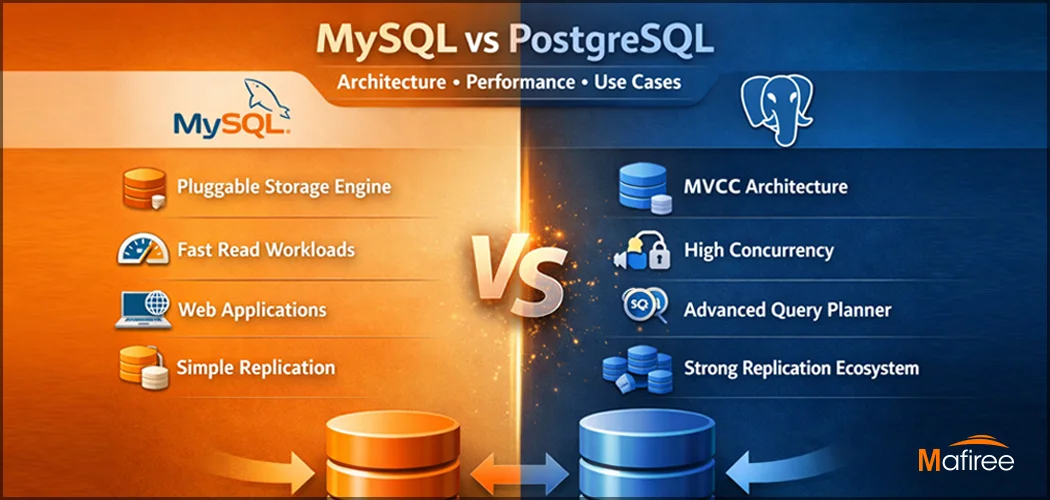
Key Differences Between MySQL and PostgreSQL: Architecture, Performance & Use Cases

Understanding the difference between MySQL and PostgreSQL is critical when choosing a database for production workloads. While both are powerful open-source relational databases, they are built with fundamentally different philosophies. This comprehensive guide compares MySQL vs PostgreSQL across architecture, performance behavior under concurrent loads, replication strategies, and real-world use cases — backed by Mafiree's 17+ years of hands-on production experience across India, APAC, and the Middle East.

  1008 views
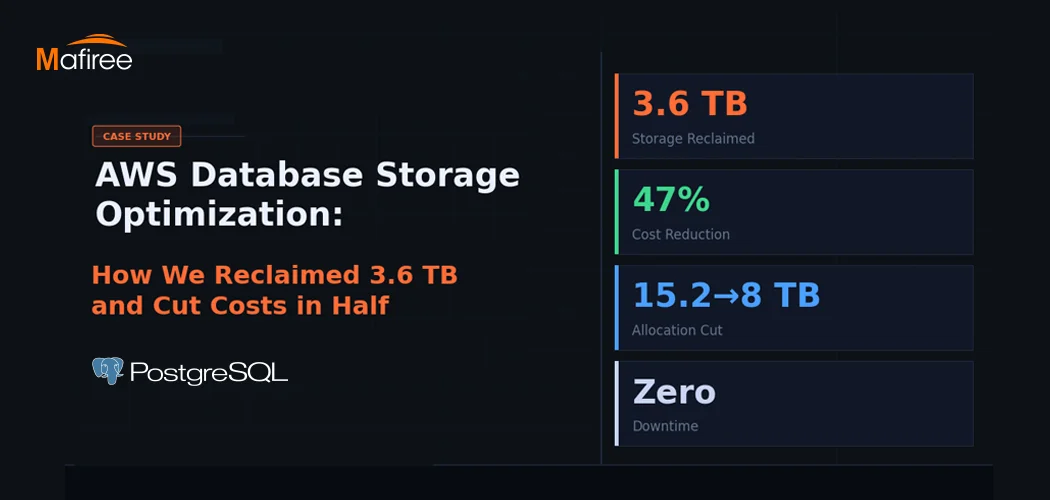
AWS Database Storage Optimization: How We Reclaimed 3.6 TB and Cut Costs in Half

A client came to us with a classic AWS database storage optimization problem: 15.2 TB allocated, less than a third actually in use — and a bill that kept growing regardless. Within one week, Mafiree had reclaimed 3.6 TB, validated a safe path to cut allocation nearly in half, and executed a zero-downtime migration. Here's the full story.

  747 views
PostgreSQL Connection Pooling: PgBouncer vs Odyssey – Performance & Configuration

PostgreSQL uses a process-per-connection model, which can limit scalability in high-traffic environments. Connection poolers help manage this challenge by reusing database connections efficiently. This blog compares PgBouncer and Odyssey, two popular PostgreSQL connection poolers, highlighting their architecture, performance characteristics, configuration differences, and ideal use cases. It helps organizations choose the right pooling solution based on workload scale, complexity, and operational requirements.

  6461 views
8 Enhancing Features in PostgreSQL 18

PostgreSQL 18: Efficiency, security, and reliability, all in one upgrade

  5760 views

Subscribe for email updates

Get in touch with us

Highlights

More than 6000 Servers Monitored

Happy Clients

Certified DBAs

24 x 7 x 365 Support

PCI

Database Services

MySQL MongoDB PostgreSQL SQL Server Aerospike Clickhouse TiDB MariaDB Columnstore

Quick Links

Careers Blog Contact Privacy Policy Disclaimer Policy

Contacts

Linkedin Mafiree Facebook Mafiree Twitter Mafiree

Nagercoil Office

Miru IT Park, Vallankumaranvillai,

Nagercoil, Tamilnadu - 629 002.

Bangalore Office

Unit 303, Vanguard Rise,

5th Main, Konena Agrahara,

Old Airport Road, Bangalore - 560 017.

Call: +91 6383016411

Email: sales@mafiree.com


Copyright © - All Rights Reserved - Mafiree