 Orbit
Orbit
 Xstreami

- About
- Services
- Blogs
- Careers
- Products
- Contact Schedule a Call
PostgreSQL uses a process-per-connection model, which can limit scalability in high-traffic environments. Connection poolers help manage this challenge by reusing database connections efficiently. This blog compares PgBouncer and Odyssey, two popular PostgreSQL connection poolers, highlighting their architecture, performance characteristics, configuration differences, and ideal use cases. It helps organizations choose the right pooling solution based on workload scale, complexity, and operational requirements.
Jethish January 28, 2026

PostgreSQL adoption continues to grow across high-traffic, business-critical systems, but connection scalability remains a common bottleneck. PostgreSQL uses a process-per-connection model, meaning each client connection consumes memory and CPU. At scale, this quickly limits performance and stability.
PostgreSQL connection pooling solves this problem by reusing database connections efficiently. In this guide, we compare PgBouncer vs Odyssey, explain when to use each, and share practical guidance based on real-world PostgreSQL implementations.
Across multiple PostgreSQL production environments, Mafiree has helped organizations address connection-driven performance bottlenecks by designing and implementing purpose-built connection pooling architectures. These environments typically involved high-concurrency workloads, stateless application tiers, and unpredictable traffic patterns where direct client-to-PostgreSQL connections were not sustainable.
Connection pooling in a database is a technique that allows multiple application clients to reuse a limited number of database connections instead of creating a new connection for every request.
In PostgreSQL, each client connection spawns a dedicated backend process. While this design provides strong isolation and stability, it also means higher memory usage and CPU overhead as the number of connections grows. In high-traffic systems, thousands of concurrent connections can quickly exhaust system resources, leading to slow queries, connection failures, and instability.
A database connection pooler sits between the application and PostgreSQL. It maintains a pool of pre-established database connections and dynamically assigns them to incoming client requests. Once a request is completed—especially in transaction pooling mode—the connection is returned to the pool and reused by another client.
In real-world implementations, we frequently observe application layers opening thousands of concurrent connections while the PostgreSQL cluster is tuned for only a few hundred active backends. Mafiree’s approach starts with workload analysis, including peak connection counts, transaction duration, idle connection behavior, and backend memory usage (work_mem, shared_buffers, per-process overhead). Based on these findings, we introduce connection poolers in front of PostgreSQL to enforce hard limits on backend processes while preserving application concurrency.

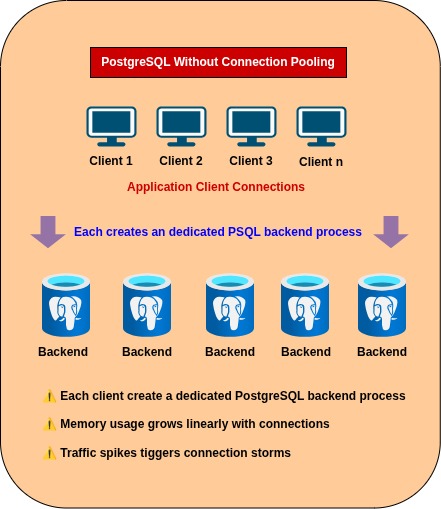
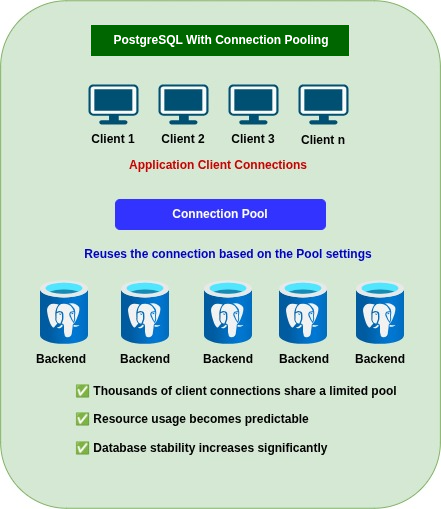
This is why connection pooling is considered a best practice for PostgreSQL scalability.
PgBouncer is a lightweight, high-performance PostgreSQL connection pooler written in C. It has been widely adopted across the PostgreSQL ecosystem and is considered the industry standard for connection pooling.
For the latest downloads, documentation refer to https://www.pgbouncer.org/ and the PgBouncer GitHub repository: https://github.com/pgbouncer/pgbouncer — both provide up-to-date releases and reference material for setup and tuning.
PgBouncer is most commonly used in transaction pooling mode, which offers an excellent balance between scalability and compatibility.
Odyssey is a modern PostgreSQL connection pooler originally developed by Yandex. It is designed for high-concurrency, cloud-native, and multi-tenant environments, where traditional poolers may reach architectural limits.
Unlike PgBouncer, Odyssey combines connection pooling with advanced routing and authentication capabilities, making it suitable for more complex deployments.
For official documentation and source releases, visit the Odyssey project site at https://pg-odyssey.tech/ or explore the Odyssey repository on GitHub at https://github.com/yandex/odyssey/ . These resources include installation instructions, configuration options, and community contributions.
| Features | PgBouncer | Odyssey |
|---|---|---|
| Architecture | Single‑threaded | Multi‑threaded |
| Pooling Modes | Session, Transaction, Statement | Session, Transaction |
| CPU Utilization | Very low | Higher but scales well |
| Configurations | Simple | Moderate–Advanced |
| Best Use Case | Most PostgreSQL workloads | Large SaaS & multi‑tenant systems |
[databases]
appdb = host=127.0.0.1 port=5432 dbname=appdb

[pgbouncer]
listen_addr = 0.0.0.0
listen_port = 6432
auth_type = md5
auth_file = /etc/pgbouncer/userlist.txt
pool_mode = transaction
max_client_conn = 10000
default_pool_size = 100
PgBouncer’s configuration is minimal, making it easy to standardize and automate across environments.
listen {
host "0.0.0.0"
port 6432
}

storage "postgres" {
type remote
host "127.0.0.1"
port 5432
}

route {
match dbname "appdb"
storage "postgres"
}

pool {
type transaction
size 100
}Some teams also evaluate Pgcat, especially in containerized environments.
While Pgcat and Pgcat Docker setups are gaining interest, PgBouncer and Odyssey remain the most widely deployed and operationally proven options. Teams evaluating PgCat vs PgDog or Pgcat vs PgBouncer should consider maturity and ecosystem support carefully.
If you are specifically looking for PostgreSQL load balancing (read/write splitting, replica routing, or traffic distribution), connection poolers alone may not be sufficient. In that case, take a look at Mafiree’s detailed guide on Load balancing options in PostgreSQL , which covers commonly used load-balancing tools and architectures.
PgBouncer is well suited for:
Odyssey is a strong choice for:
Mafiree also assists teams in tuning pooler parameters such as pool size, reserve pools, timeouts, and authentication handling to match application behavior. In cases involving long-running transactions or session-level state, we guide customers on when session pooling or alternative poolers like Odyssey are more appropriate. This ensures pooling improves scalability without breaking application semantics.
By treating connection pooling as an architectural component rather than a simple proxy, Mafiree helps teams achieve immediate performance gains while building a PostgreSQL platform that scales safely as traffic grows.
.webp)
Ask these questions before choosing a pooler:
For many organizations, PgBouncer is sufficient. At extreme scale or complexity, Odyssey or Pgcat may be better suited.
Both PgBouncer and Odyssey are excellent PostgreSQL connection poolers—but they serve different needs.
From Mafiree’s field experience, PgBouncer remains the safest and most effective choice for the majority of high-throughput PostgreSQL workloads, particularly when transaction-level pooling is viable. For more complex environments that require session awareness, multi-database routing, or tighter integration with authentication and failover workflows, alternatives like Odyssey can be a better architectural fit.
The key takeaway is that connection pooling should be designed deliberately, tested under peak load, and revisited as application patterns evolve. When implemented correctly, it simplifies scaling, improves resilience during traffic spikes and failovers, and extends the usable life of PostgreSQL infrastructure. This is why connection pooling is one of the first areas Mafiree evaluates when helping teams build reliable, high-performance PostgreSQL platforms.
Mafiree offers PostgreSQL consulting in Asia, helping teams in India optimize database performance, scalability, and reliability. From connection pooling design and high-availability architectures to PostgreSQL migrations and performance tuning, Mafiree works closely with engineering teams to build resilient, production-ready PostgreSQL platforms.
Connection pooling is only one part of building a scalable PostgreSQL platform. In practice, choosing the right pooler, tuning it correctly, and integrating it with high-availability, replication, and application behavior requires deep PostgreSQL expertise.
Mafiree works with engineering and platform teams to design, optimize, and operate PostgreSQL at scale, including:
Across SaaS platforms, fintech systems, and high-traffic applications, Mafiree helps organizations eliminate connection bottlenecks, stabilize traffic spikes, and extend the lifecycle of their PostgreSQL infrastructure.
If you’re evaluating PgBouncer vs Odyssey, facing connection storms, or planning PostgreSQL scaling or migration, Mafiree’s PostgreSQL experts can help you design a solution tailored to your workload.
Learn more about Mafiree’s PostgreSQL consulting and optimization services
More than 6000 Servers Monitored
Happy Clients
Certified DBAs
24 x 7 x 365 Support



Miru IT Park, Vallankumaranvillai,
Nagercoil, Tamilnadu - 629 002.
Unit 303, Vanguard Rise,
5th Main, Konena Agrahara,
Old Airport Road, Bangalore - 560 017.
Call: +91 6383016411
Email: sales@mafiree.com