
Slow MySQL incident resolution is often a symptom of a weak support model—not just a technical problem. Learn how to identify gaps in escalation, monitoring, automation, DBA expertise, and post-incident reviews before they lead to recurring downtime.
Shenbaga Varna S September 23, 2026
Slow MySQL incident response becomes a support-model problem when incidents repeatedly take too long to diagnose or resolve, the same failures recur, escalation is unclear, or teams rely heavily on manual troubleshooting. These patterns usually indicate gaps in monitoring, DBA expertise, automation, incident ownership, or post-incident learning.
Common warning signs
When a critical MySQL database issue arises, the speed of your incident response can make or break your business continuity. Yet many organizations struggle with slow fixes — not because they lack tools, but because their support model is fundamentally flawed.
MySQL incident response isn't just about fixing errors — it's about how quickly and effectively your team identifies, isolates, and resolves issues. When fixes take hours or even days, it's not just a technical problem; it's a systemic one.
Slow incident resolution can stem from several underlying database problems. For example, recurring performance bottlenecks may require a structured approach to diagnosing and fixing MySQL performance issues rather than repeatedly treating the symptoms.

| What you observe | What it may indicate | What to investigate |
|---|---|---|
| Long time to identify root cause | Weak diagnostics / limited DBA expertise | Monitoring, query analysis, logs, escalation |
| Incidents wait hours for escalation | Unclear ownership | On-call structure and escalation paths |
| Same issue keeps returning | No effective post-mortem process | Root-cause analysis and corrective actions |
| Engineers manually repeat recovery steps | Low automation | Runbooks, scripts, automated recovery |
| Users report issues before monitoring does | Reactive monitoring | Query latency, connections, disk, replication |
| Different teams troubleshoot independently | Poor incident coordination | Incident commander and communication process |
Repeatedly resolving MySQL incidents without identifying their root cause is a sign that the support model is optimized for recovery rather than prevention.
What this looks like
What to change
Use a structured root-cause analysis process that documents the trigger, contributing factors, resolution, and preventive action. For performance-related incidents, a detailed MySQL performance issue diagnosis can help distinguish query, indexing, configuration, and infrastructure problems.
Teams that don't communicate clearly during an incident often waste time and resources. Miscommunication leads to duplicated efforts, incorrect assumptions, and delayed fixes. A clearly defined escalation path should also specify when issues involving replication, failover, or availability require specialist intervention.
Manual interventions are slow and error-prone. If your team relies heavily on manual steps for incident resolution, it's a clear sign that automation is missing from your support model. Automating monitoring and failover workflows can significantly reduce this manual burden — for example, MySQL high availability with Orchestrator can automate key failover processes.
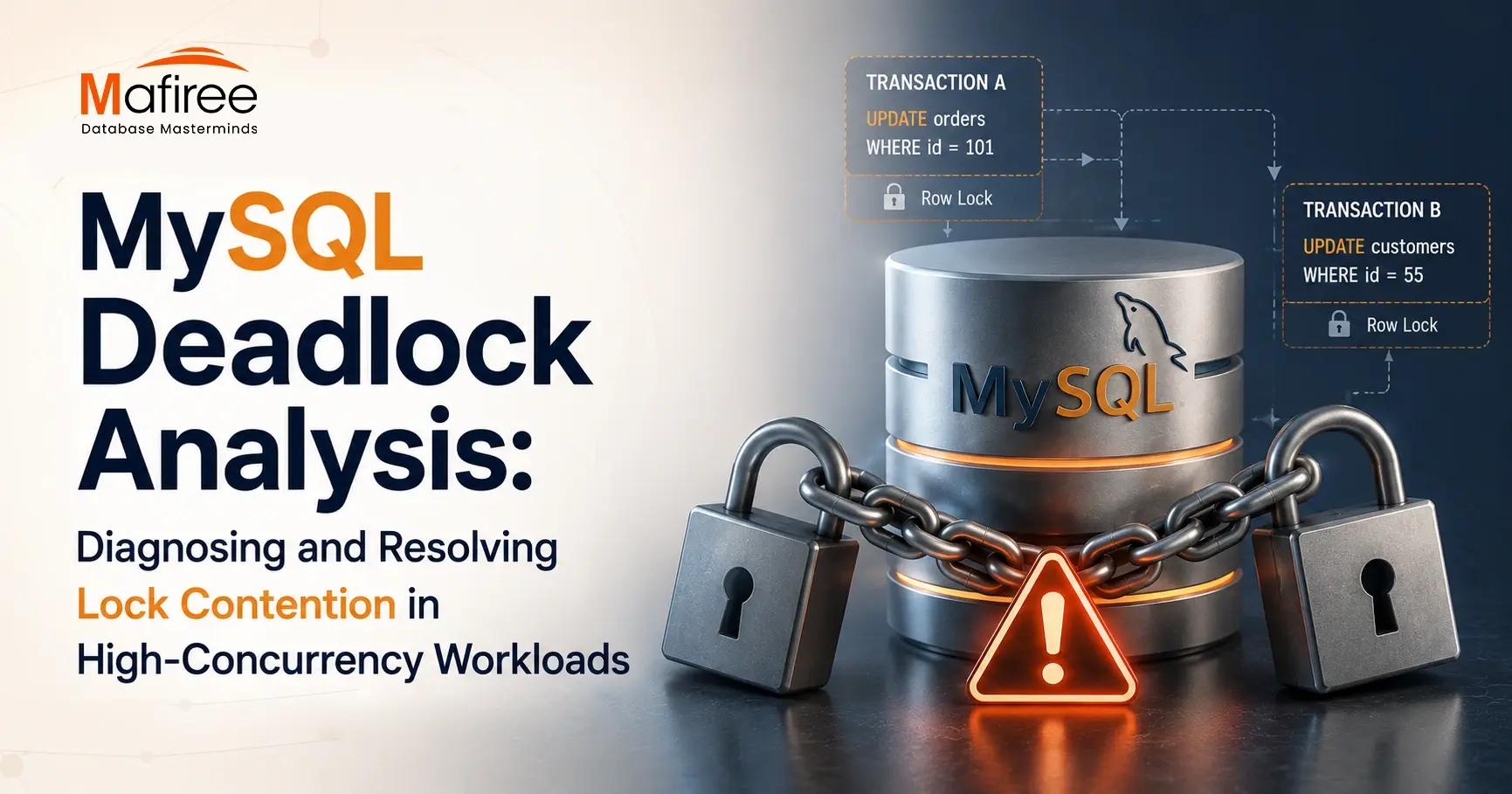
Without analyzing what went wrong and how it was fixed, you miss opportunities to improve. Regular post-mortems are essential for strengthening your incident response over time. They should also identify recurring technical causes — such as MySQL deadlocks — that require a permanent fix rather than another temporary recovery.
Every MySQL post-incident review should capture:
Mafiree brings deep expertise in database incident management, helping organizations reduce downtime and accelerate resolution times. Our approach includes:
Whether you're facing a critical outage or need to optimize your existing response model, learn more about our MySQL consulting.
Mafiree's DBAs can review your escalation path, monitoring, and automation gaps — then close them.
Request a Support-Model ReviewEnsure that every incident has a defined owner and escalation path. This prevents confusion during high-pressure situations.
Use tools to monitor key metrics like query latency, connection counts, disk usage, and replication health. For high-availability environments, understanding MySQL high availability with Orchestrator can also help teams design more resilient failure detection and recovery.
Automate routine tasks such as backups, log rotation, and basic diagnostics. For teams dealing with recurring database performance incidents, MySQL performance tuning can also help address the underlying causes rather than repeatedly automating recovery from the same symptoms.
After each incident, analyze what happened, how it was resolved, and what could be improved. Document lessons learned and update your processes accordingly.
| Metric | What it measures |
|---|---|
| MTTD | Mean time to detect an incident |
| MTTA | Mean time to acknowledge/escalate |
| MTTR | Mean time to restore or resolve |
| Recurrence rate | How often similar incidents return |
| First-response time | How quickly an engineer begins investigation |
A support model shouldn't be evaluated only by MTTR. A team can reduce resolution time while still failing to detect incidents early or prevent recurrence. MTTD, MTTA, MTTR and recurrence rate should be evaluated together.
Not every organization has the in-house depth to diagnose complex or recurring MySQL issues, maintain 24/7 on-call coverage, or run structured post-incident reviews. External MySQL DBA support is worth considering when incidents keep recurring despite internal fixes, when escalation depends on one or two individuals, or when your team needs specialist expertise for diagnostics, automation, or high-availability design.
Related Mafiree Resources
Slow MySQL incident response isn't just a technical inconvenience — it's a symptom of a broader support model that needs attention. By identifying the root causes behind delayed fixes, you can build a more resilient and efficient database environment. This is particularly important when recurring MySQL performance issues are contributing to repeated incidents.
If your organization is struggling with slow incident resolution or recurring database problems, MySQL consulting and DBA support can provide specialist expertise for diagnosis, remediation, monitoring, and ongoing incident response.
Let Mafiree's database experts handle your critical incidents with speed and precision.
Talk to a MySQL DBA ExpertMiru IT Park, Vallankumaranvillai,
Nagercoil, Tamilnadu - 629 002.
Unit 303, Vanguard Rise,
5th Main, Konena Agrahara,
Old Airport Road, Bangalore - 560 017.
Call: +91 6383016411
Email: sales@mafiree.com