 Orbit
Orbit
 Xstreami

- About
- Services
- Blogs
- Careers
- Products
- Contact Schedule a Call
Zero-Code ETL simplifies data integration by replacing complex coding with visual workflows, automation, and prebuilt connectors. It helps businesses deploy pipelines faster, reduce maintenance effort, support real-time data movement, and scale operations more efficiently, allowing teams to focus on insights rather than managing infrastructure.
Shenbaga Varna S July 27, 2026

Every business today depends on data.
When someone places an order online, opens a mobile app, makes a payment, or browses a website, data is created instantly. But this information usually gets stored across different systems like databases, applications, analytics platforms, and cloud services.
The real challenge is not generating data. The challenge is moving that data smoothly between systems without delays or complications. For years, businesses relied on ETL pipelines to handle this process.
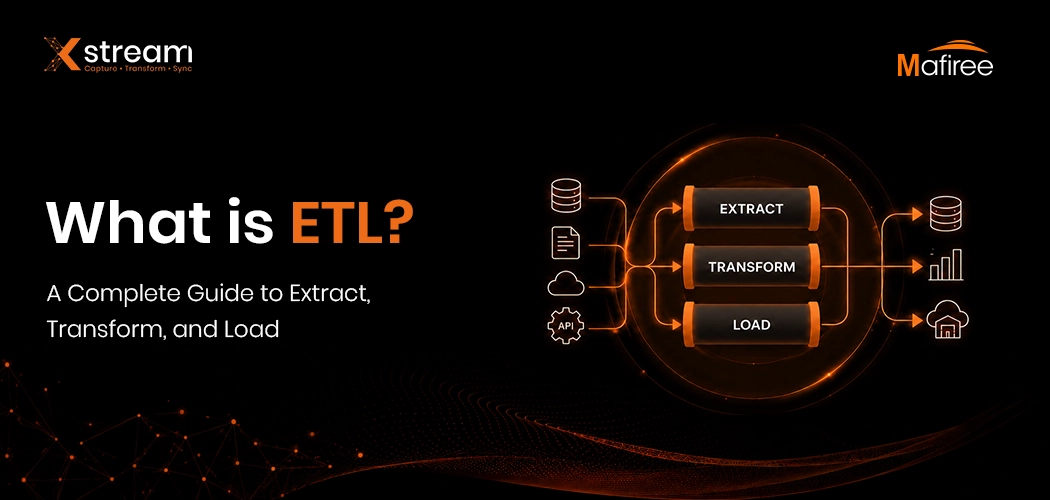
ETL stands for:
While the idea sounds simple, traditional ETL systems were often difficult to manage.
Developers had to write scripts, configure APIs, maintain workflows, monitor failures, and constantly update integrations whenever systems changed. Even a small database modification could interrupt the entire pipeline.
As businesses grew and real-time operations became more important, managing these pipelines became increasingly complex.
This is where Zero-Code ETL started changing the way businesses handle data. Instead of building everything manually through code, teams can now create pipelines using visual workflows, automation, prebuilt connectors, and real-time synchronization. In simple terms, Zero-Code ETL helps businesses move and manage data more efficiently without depending heavily on complex coding and continuous maintenance.

Imagine an e-commerce company that receives thousands of orders every day.
The company wants all its sales information to automatically appear inside dashboards, reporting systems, and analytics platforms in real time.
In a traditional ETL setup, developers would usually need to:
This process could take significant time and ongoing maintenance. With Zero-Code ETL, the process becomes much simpler.
Instead of coding everything manually, users can connect systems through visual interfaces, configure workflows, and automate how data moves between platforms.
The platform handles much of the technical complexity behind the scenes.
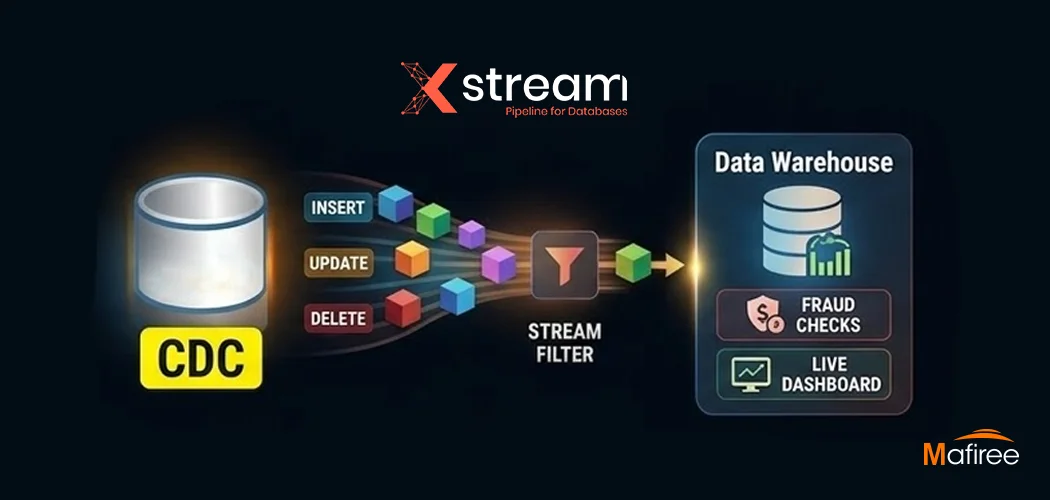
Modern businesses are also increasingly adopting real-time MySQL CDC architectures, where database changes are continuously streamed between systems instead of waiting for scheduled batch updates.
This helps organizations keep dashboards, analytics platforms, and operational systems updated continuously without delays. Businesses building scalable data ecosystems are also moving toward real-time MySQL streaming for analytics and AI, helping teams process information faster and make quicker decisions.
Xstreami helps simplify these workflows by making deployment, synchronization, and real-time pipeline management easier for growing businesses.

A few years ago, heavy manual coding was considered normal in data engineering. Even small pipelines often require SQL queries, Python scripts, infrastructure configuration, and constant debugging.
As systems expanded, maintaining these pipelines became increasingly difficult. A failed connection or schema change could stop the entire flow of data.
Over time, organizations realized they were spending more time fixing pipelines than actually using data effectively.
Zero-Code ETL introduced a much simpler approach. Instead of continuously building and maintaining integrations manually, teams can automate repetitive workflows and configure pipelines visually. This reduces:
More importantly, businesses can focus more on insights, analytics, and growth instead of infrastructure management.
Modern businesses operate in real time. Teams no longer want to wait hours for reports to refresh or systems to synchronize. They need live dashboards, instant analytics, operational visibility, and faster access to information.
Traditional ETL systems often struggle to support these expectations because they require continuous engineering support and manual maintenance.
Zero-Code ETL helps simplify this process by making workflows easier to build, manage, and scale.
Businesses prefer this approach because it helps them:
As organizations scale, pipeline management becomes even more challenging, especially when handling workloads that involve streaming billions of records in real time across distributed systems.
This is why businesses are increasingly investing in scalable real-time architectures that support continuous synchronization and high-volume data movement.
Today, businesses depend heavily on real-time information.
Banks monitor transactions instantly.
E-commerce companies track live orders.
AI systems process incoming information continuously.
Logistics and transportation platforms monitor operational systems in real time.
Traditional batch-based ETL pipelines were not designed for this level of speed and continuous synchronization. Modern Zero-Code ETL platforms simplify this process by continuously syncing updated data between systems.
Many organizations now rely on operationally simple CDC pipelines that continuously stream database updates without repeatedly transferring entire datasets. This helps businesses:
Organizations building advanced analytics environments are increasingly adopting reliable real-time MySQL streaming pipelines to support large-scale analytics and AI workloads efficiently.

The biggest reason Zero-Code ETL became popular is usability. Most platforms are designed to simplify complex integrations using automation and visual workflows.
Instead of writing large amounts of code, users can configure pipelines using drag-and-drop interfaces, automated scheduling, prebuilt connectors, monitoring dashboards, and transformation tools. This makes data integration more accessible not only for developers but also for analysts, operations teams, and business users.
The result is faster collaboration and reduced operational complexity across organizations.
Zero-Code ETL simplifies this process by reducing manual development, accelerating deployment, and making data integration more accessible across teams. The table below highlights the key differences between Traditional ETL and Zero-Code ETL.
Feature | Traditional ETL | Zero-Code ETL |
| Development Approach | Requires manual coding, scripting, and custom integrations | Uses visual workflows, automation, and prebuilt connectors |
| Technical Expertise | Relies heavily on developers and data engineers | Accessible to developers, analysts, and business users |
| Deployment Speed | Slower deployment due to custom development | Faster deployment through configuration-based setup |
| Maintenance Effort | Requires continuous monitoring, debugging, and updates | Simplified maintenance with automated management |
| Scalability | Scaling often requires additional engineering effort | Designed to scale more easily as data volumes grow |
| Workflow Management | Complex and manually managed | Simplified through visual interfaces and automation |
| Handling System Changes | Schema or application changes can disrupt pipelines | More adaptable with reduced manual intervention |
| Operational Overhead | Higher infrastructure and maintenance burden | Lower operational complexity |
| Time to Value | Longer implementation and onboarding cycles | Faster delivery of data pipelines and integrations |
| Real-Time Data Support | Often optimized for batch processing and scheduled jobs | Better suited for modern real-time and continuous data synchronization environments |
Almost every industry today depends on ETL pipelines.
An e-commerce company may move order data into dashboards.
Financial platforms may monitor transactions in real time.
Healthcare systems may synchronize patient information across applications.
Transportation and logistics companies may continuously process live operational data from multiple systems.
In industries where systems generate massive amounts of information every second, real-time ETL at scale becomes critical for maintaining operational visibility and faster decision-making.
Businesses managing complex operational ecosystems are increasingly adopting scalable ETL architectures to simplify synchronization, analytics, and large-scale data movement.
Xstreami helps organizations simplify these workflows through scalable synchronization and easier real-time pipeline management.
One of the biggest advantages of Zero-Code ETL is accessibility. Earlier, ETL systems depended almost entirely on developers and data engineers because the process involved heavy coding and infrastructure management.
Modern zero-code platforms make data integration easier for analysts, operations teams, and business users as well. This does not mean technical understanding becomes unnecessary. Understanding workflows and data movement still matters. However, platforms like Xstreami reduce the need for complex manual coding and make collaboration easier across teams.
Although Zero-Code ETL simplifies many workflows, it is not a perfect solution for every situation. Some businesses may still require:
Organizations may also face challenges related to scalability planning, vendor dependency, and highly complex workflows. This is why choosing the right platform is important.
The ideal ETL solution should simplify operations while still supporting scalability, reliability, and modern real-time requirements.
Businesses today generate more data than ever before. Managing integrations manually is becoming increasingly difficult, time-consuming, and expensive.
Organizations now need:
Zero-Code ETL addresses these challenges by making data movement easier, faster, and more accessible.
Instead of spending large amounts of time managing infrastructure manually, teams can focus more on using data to improve analytics, customer experiences, and business operations.

Modern businesses depend heavily on data, but managing that data often becomes increasingly complex as systems grow.
Many organizations still struggle with pipelines that are difficult to deploy, expensive to maintain, and heavily dependent on continuous engineering support. Small schema changes, failed integrations, infrastructure issues, or growing streaming workloads can interrupt operations and create delays.
Traditional ETL systems often require constant monitoring, repeated troubleshooting, and ongoing manual maintenance just to keep workflows running smoothly. This is where Xstreami, introduced by Mafiree, helps simplify modern data operations. Instead of spending countless hours building and maintaining integrations manually, businesses can create scalable real-time pipelines using simplified workflows, automation, and database migration strategies. Whether organizations are building streaming systems, analytics platforms, AI pipelines, or operational dashboards, Xstreami helps simplify deployment, synchronization, and large-scale data movement while reducing operational complexity.
The goal of Zero-Code ETL is not to remove technology. The goal is to remove unnecessary complexity so businesses can focus more on using data effectively instead of constantly managing infrastructure behind the scenes.
More than 6000 Servers Monitored
Happy Clients
Certified DBAs
24 x 7 x 365 Support



Miru IT Park, Vallankumaranvillai,
Nagercoil, Tamilnadu - 629 002.
Unit 303, Vanguard Rise,
5th Main, Konena Agrahara,
Old Airport Road, Bangalore - 560 017.
Call: +91 6383016411
Email: sales@mafiree.com