
Mafiree logo
  • About
  • Services
  • Blogs
  • Careers
  • Products
    • orbit logo Orbit
    • streamer logo Xstreami
  • Contact
Schedule a Call
Menu
  • About
  • Services
  • Blogs
  • Careers
  • Products
    • orbit logo Orbit
    • streamer logo Xstreami
  • Contact
  • Schedule a Call
Database
Database Database Managed Services
MySQL MySQL
MySQL Consulting Services
MySQL Migration Services
MySQL Optimization & Query Tuning
MySQL Database Administration
MySQL Backup & Recovery
MySQL Security & Maintenance
MySQL Cloud Services (AWS RDS, Aurora, Google Cloud SQL, Azure)
MySQL for Ecommerce
MySQL High Availability & Replication
MongoDB MongoDB
MongoDB Consulting Services
MongoDB Migration Services
MongoDB Optimization & Query Tuning
MongoDB Database Administration
MongoDB Backup & Recovery
MongoDB Security & Maintenance
MongoDB Cloud (Atlas)
MongoDB Solutions by Industry
MongoDB High Availability & Replication
PostgreSQL PostgreSQL
PostgreSQL Consulting
PostgreSQL Migration & Upgrades
Performance Tuning & Query Optimization
PostgreSQL Administration & Managed Services
High Availability, Clustering & Replication
PostgreSQL Backup, Recovery & Disaster Planning
PostgreSQL Security, Compliance & Auditing
PostgreSQL for Analytics & Data Warehousing
PostgreSQL on Cloud & Containers
PostgreSQL Extensions & Open-Source Integrations
PostgreSQL for Every Industry
SQL Server MSSQL
MSSQL Consulting Services
MSSQL Migration Services
MSSQL Optimization & Query Tuning Services
MSSQL Database Administration Services
MSSQL Backup & Recovery Services
MSSQL High Availability & Replication Services
MSSQL Security & Compliance Services
MSSQL Performance Monitoring & Health Checks
MSSQL Solutions by Industry
Aerospike Aerospike
Aerospike Consulting Services
Aerospike Migration Services
Aerospike Performance Optimization & Tuning
Aerospike Database Administration
Aerospike Backup & Recovery
Aerospike High Availability
Aerospike Cloud & Hybrid Deployments
Aerospike for Real-Time Applications (AdTech, FinTech, Retail, IoT)
Analytics DB
Analytics DB Analytics DB Services
Clickhouse Clickhouse
ClickHouse Consulting Services
ClickHouse Migration Services
ClickHouse Optimization & Query Tuning
ClickHouse Database Administration
ClickHouse Backup & Recovery
ClickHouse Security & Maintenance
ClickHouse Cloud Services (ClickHouse Cloud, AWS, GCP, Azure)
ClickHouse Solutions by Industry
ClickHouse High Availability & Replication
TiDB TiDB
TiDB Consulting & Architecture Planning
TiDB Administration & Maintenance
TiDB Security and Privacy Maintenance
TiDB Performance & Query Optimization
TiDB Migration Services
TiDB Backup & Disaster Recovery
TiDB High Availability Solutions
TiDB Solutions by Industry
TiDB Cloud Services
ScyllaDB ScyllaDB
ScyllaDB Consulting & Architecture Planning
ScyllaDB Administration & Maintenance
ScyllaDB Security and Privacy Maintenance
ScyllaDB Performance & Query Optimization
ScyllaDB Migration Services
ScyllaDB Backup & Disaster Recovery
ScyllaDB High Availability Solutions
ScyllaDB Solutions by Industry
ScyllaDB Cloud Services
DevOps
DevOps DevOps Services
Version Control Version Control
Kubernetes Kubernetes
Infrastructure Infrastructure Management
Web Servers Web Servers
Networking
Networking Networking Services
Basic Basic
Advanced Advanced
MySQL MySQL
MongoDB MongoDB
PostgreSQL PostgreSQL
MSSQL MSSQL
Aerospike Aerospike
Clickhouse Clickhouse
TiDB TiDB
ScyllaDB ScyllaDB
Version Control Version Control
Kubernetes Kubernetes
Infrastructure Infrastructure Management
Web Servers Web Servers
Basic Basic
Advanced Advanced
MySQL Consulting Services
MySQL Migration Services
MySQL Optimization & Query Tuning
MySQL Database Administration
MySQL Backup & Recovery
MySQL Security & Maintenance
MySQL Cloud Services (AWS RDS, Aurora, Google Cloud SQL, Azure)
MySQL for Ecommerce
MySQL High Availability & Replication
MongoDB Consulting Services
MongoDB Migration Services
MongoDB Optimization & Query Tuning
MongoDB Database Administration
MongoDB Backup & Recovery
MongoDB Security & Maintenance
MongoDB Cloud (Atlas)
MongoDB Solutions by Industry
MongoDB High Availability & Replication
PostgreSQL Consulting
PostgreSQL Migration & Upgrades
Performance Tuning & Query Optimization
PostgreSQL Administration & Managed Services
High Availability, Clustering & Replication
PostgreSQL Backup, Recovery & Disaster Planning
PostgreSQL Security, Compliance & Auditing
PostgreSQL for Analytics & Data Warehousing
PostgreSQL on Cloud & Containers
PostgreSQL Extensions & Open-Source Integrations
PostgreSQL for Every Industry
MSSQL Consulting Services
MSSQL Migration Services
MSSQL Optimization & Query Tuning Services
MSSQL Database Administration Services
MSSQL Backup & Recovery Services
MSSQL High Availability & Replication Services
MSSQL Security & Compliance Services
MSSQL Performance Monitoring & Health Checks
MSSQL Solutions by Industry
Aerospike Consulting Services
Aerospike Migration Services
Aerospike Performance Optimization & Tuning
Aerospike Database Administration
Aerospike Backup & Recovery
Aerospike High Availability
Aerospike Cloud & Hybrid Deployments
Aerospike for Real-Time Applications (AdTech, FinTech, Retail, IoT)
ClickHouse Consulting Services
ClickHouse Migration Services
ClickHouse Optimization & Query Tuning
ClickHouse Database Administration
ClickHouse Backup & Recovery
ClickHouse Security & Maintenance
ClickHouse Cloud Services (ClickHouse Cloud, AWS, GCP, Azure)
ClickHouse Solutions by Industry
ClickHouse High Availability & Replication
TiDB Consulting & Architecture Planning
TiDB Administration & Maintenance
TiDB Security and Privacy Maintenance
TiDB Performance & Query Optimization
TiDB Migration Services
TiDB Backup & Disaster Recovery
TiDB High Availability Solutions
TiDB Solutions by Industry
TiDB Cloud Services
ScyllaDB Consulting & Architecture Planning
ScyllaDB Administration & Maintenance
ScyllaDB Security and Privacy Maintenance
ScyllaDB Performance & Query Optimization
ScyllaDB Migration Services
ScyllaDB Backup & Disaster Recovery
ScyllaDB High Availability Solutions
ScyllaDB Solutions by Industry
ScyllaDB Cloud Services
  1. Home
  2. > Blogs
  3. > Xstreami
  4. > What is ETL? How Modern ETL Pipelines Power Real-Time Data

What is ETL? How Modern ETL Pipelines Power Real-Time Data

Modern systems don’t suffer from a lack of data — they suffer from too much of it, in too many places. Every service, application, and platform generates its own stream of information. Transactions, logs, user actions, system events — all flowing continuously, but rarely in sync. The real challenge isn’t collecting data anymore. It’s making sense of it. That’s where ETL begins its quiet work in the background.

Shenbaga Varna S May 20, 2026

Subscribe for email updates

The Hidden Chaos Behind Business Data

No one sees it at first.


On the surface, dashboards look clean, reports are structured, and numbers seem reliable. But underneath, data is scattered across systems that were never designed to work together.


A transaction lives in one database.

A user action is logged elsewhere. 

Operational signals exist in entirely different formats. 

Each system works independently, but together they create fragmentation.

So when a business asks a simple question, the answer becomes complicated — not because the data doesn’t exist, but because it isn’t connected.

This is the hidden chaos: data that is everywhere, yet not immediately usable.
 

What is ETL?

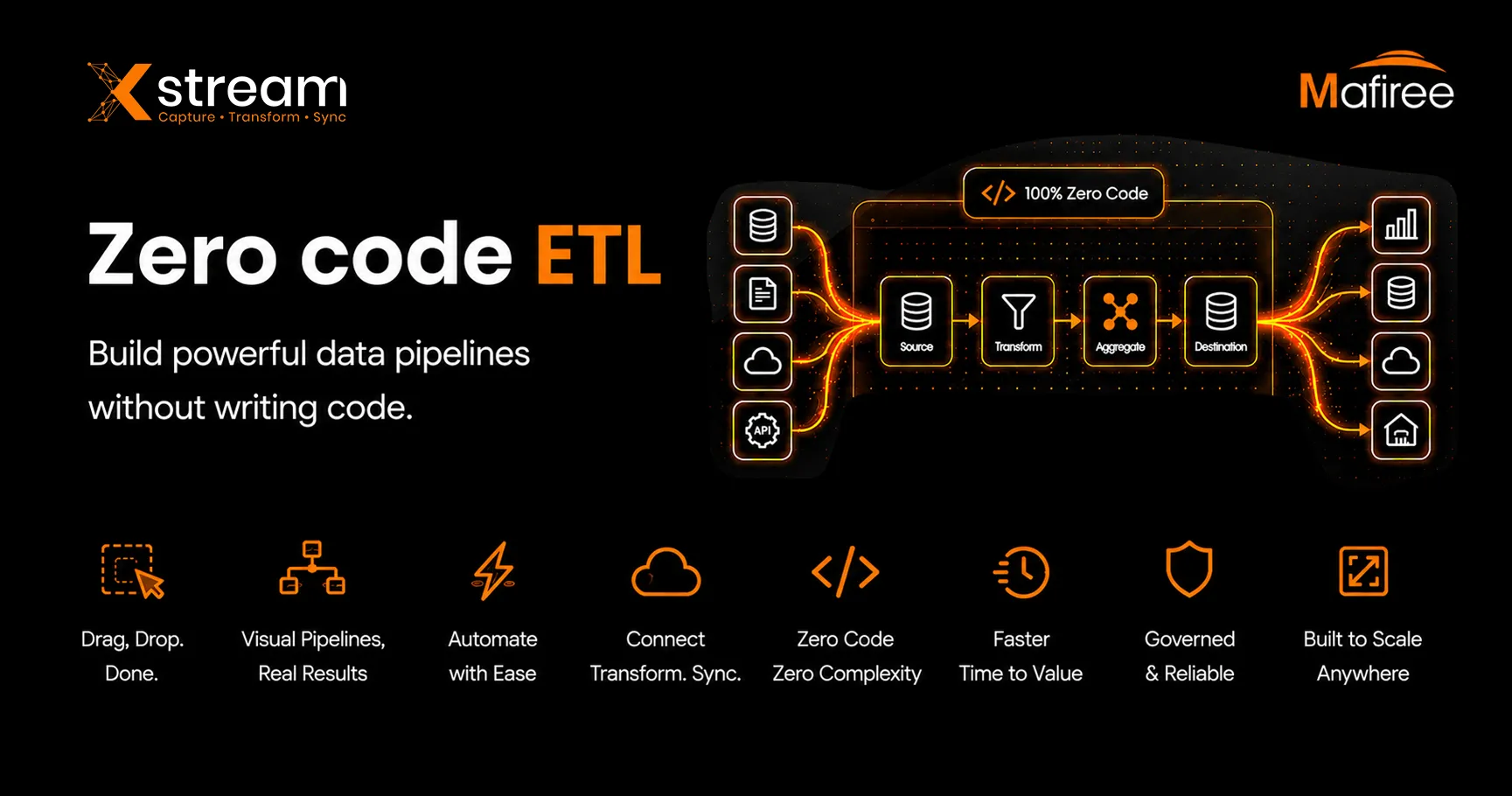
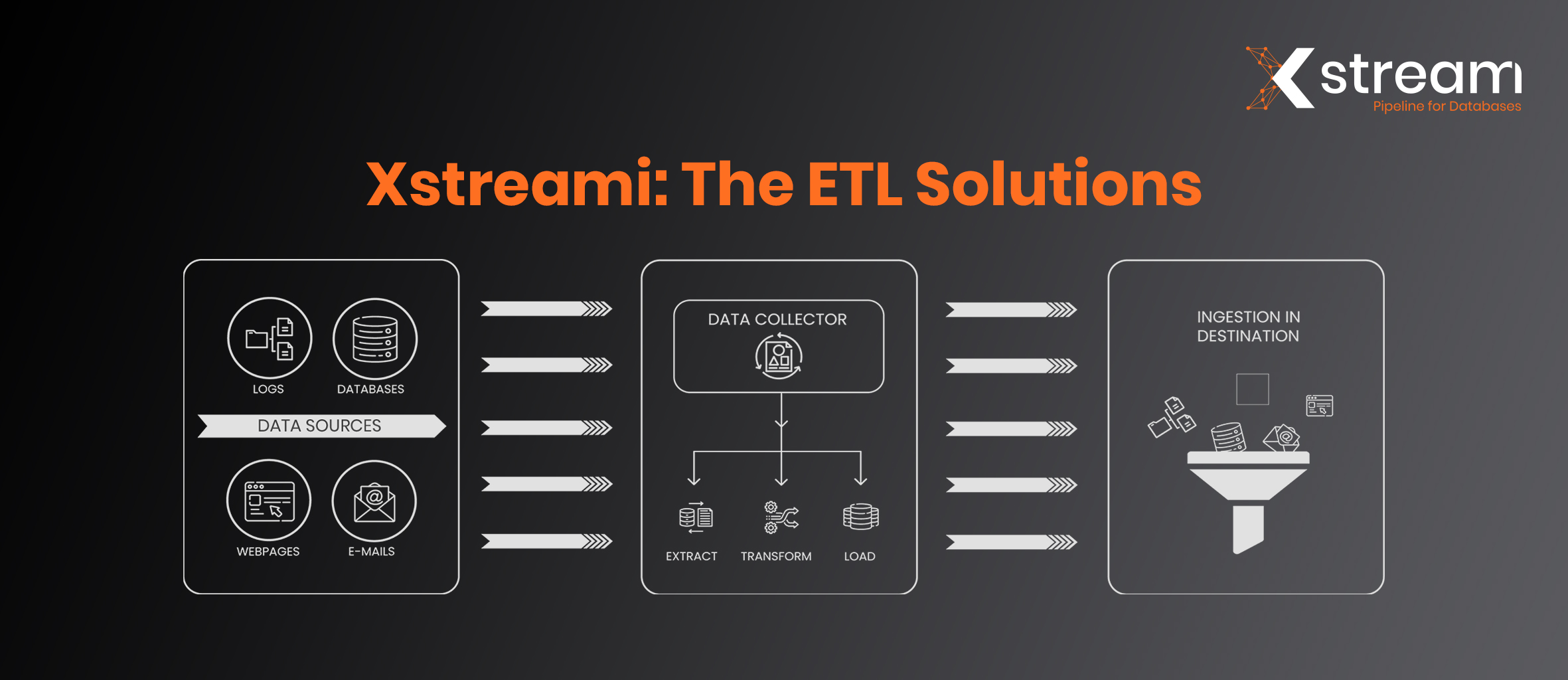
ETL stands for Extract, Transform, Load. It is a data integration process used to collect data from multiple sources, clean and standardize it, and move it into a destination system such as a data warehouse, analytics platform, or operational environment.

ETL solution for real-time pipelines  helps businesses turn disconnected raw data into trusted, usable insights.


The ETL Process in 3 Steps

  • Extract – Collect data from databases, applications, APIs, logs, and external systems
  • Transform – Clean, validate, standardize, enrich, and restructure data
  • Load – Deliver processed data into warehouses, dashboards, lakehouses, or real-time systems 

Understanding ETL in Modern Data Systems

Let’s imagine something simple — but very real.


A payment happens on an app.
At the same moment:

  • The transaction is stored in a database
  • The user’s action is recorded as an event
  • A fraud system quietly logs signals in the background —inside the code block

Now here’s the interesting part. All of this data exists.
But it exists in different places, in different formats, and at different speeds.


If someone now asks:
“Is this transaction safe?”

No single system can answer it alone.


The transaction system only knows the payment.
The user system only knows the behavior.
The fraud system only knows patterns.


Individually, they are useful. But together, they tell the full story. This is where ETL comes in.

ETL acts like a smart connector that quietly does three things:


  • It collects data from all these systems as it happens
  • It cleans and aligns the data so everything makes sense together
  • It delivers it to a place where it can be analyzed instantly

So instead of looking at three separate pieces. You now see one complete picture. A transaction is no longer just a record.

It becomes a combination of:

  • What happened
  • Who did it
  • Whether it looks risky

That’s what ETL really does in modern systems. It doesn’t just move data. 

It connects pieces of information so systems can think together, not separately.


ETL Architecture


Data Ingestion: The First Step of ETL

In older systems, data was extracted in bulk — large queries, scheduled jobs, periodic pulls.

But modern systems don’t wait. Instead of periodic pulls, data is captured as it occurs.

So when something happens:


  • A database update is recorded through change logs using  Change Data Capture (CDC).
  • An application event is streamed the moment it occurs
  • A system action is pushed into a pipeline instantly

Nothing is reprocessed unnecessarily. Only what changes is captured and moved forward. This approach changes everything.

Data ingestion becomes continuous, not periodic. It becomes lightweight, not disruptive. And most importantly, it keeps systems running without interference while still making data available in near real time.


Cleaning, Standardizing, and Enriching Data

Once data starts flowing in, the illusion of completeness disappears.

Because raw data, in its natural state, is unreliable.

  • Two systems may store timestamps differently.
  • Identifiers may not align.
  • Duplicates creep in.
  • Critical context is often missing.

Transformation is where discipline is introduced in the Real-Time CDC deployment


  • Data is cleaned — removing inconsistencies and errors.
  • It is standardized — aligned to common formats and structures.
  • And then it is enriched — connected with other datasets to add meaning.

A transaction alone is just a record.
Combined with user data, location, and behavioral patterns… it becomes insight.

This stage doesn’t just improve data — it defines whether it can be trusted at all.


Batch vs Real-Time Data Loading

There was a time when data pipelines moved at a slower pace.

Processing happened in batches — hourly, nightly, sometimes even less frequently. For reporting and historical analysis, this worked well. But modern systems operate in a different reality.

  • Decisions are expected instantly.
  • Systems react in real time.
  • Delays are no longer acceptable.

So data loading has evolved.

Instead of waiting to accumulate, data is pushed forward the moment it’s ready. Dashboards update continuously. Alerts trigger as events occur. Systems respond without pause.

The difference is subtle, but powerful:

  • From data that informs later to data that acts immediately.

Change Data Capture in Modern ETL Pipelines

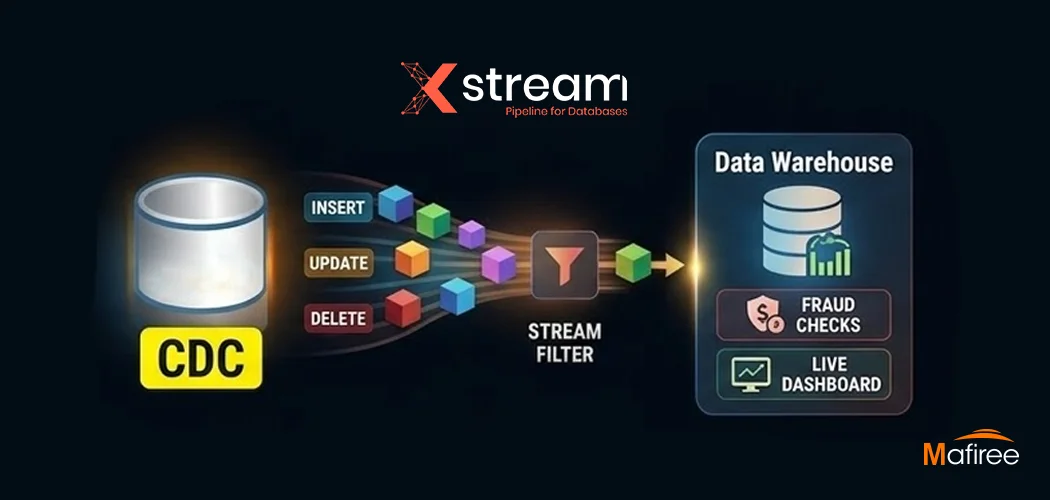
Change Data Capture (CDC) is one of the most important technologies powering real-time ETL.

Rather than re-reading entire databases, CDC captures only inserts, updates, and deletes as they happen.

Benefits of CDC include:

  • Lower database load
  • Faster synchronization
  • Real-time analytics readiness
  • Better pipeline efficiency
  • Reduced infrastructure costs


CDC is especially valuable for MySQL, PostgreSQL, Oracle, and enterprise transactional systems where speed matters.


What is ETL?


How ETL Pipelines Work Internally

Behind this seamless flow lies a carefully engineered system.

ETL pipelines are not linear scripts — they are distributed, fault-tolerant architectures designed to handle constant movement.

  • Data enters through ingestion layers that capture changes and events.
  • It moves through processing engines that apply transformations in parallel.
  • Orchestration systems manage dependencies, retries, and execution flow.
  • Finally, it is delivered into storage systems optimized for querying and analysis.

At every stage, the system is designed to handle scale, failure, and speed.

Because in modern environments, data doesn’t pause — and neither can the pipeline.


The Shift from Batch to Real-Time ETL

This is where ETL has undergone its most significant transformation. What was once scheduled and predictable is now continuous and dynamic.


Instead of waiting for jobs to run, pipelines respond to events.
Instead of processing large chunks, they handle streams.

This shift points to a deeper transformation in the way businesses function today. Questions are no longer retrospective. They are immediate.


Not “What happened yesterday?”
But “What’s happening right now?”

And ETL has adapted to answer that — in real time.


Real-Time Data Processing Use Cases

This evolution is not theoretical. It’s already shaping critical systems.

  • A payment anomaly is detected before a transaction completes.
  • A user’s experience adapts in real time based on behavior.
  • Operational systems trigger alerts before failures escalate.

These capabilities depend on one thing:

Data that is not just available — but instantly usable. And that is exactly what modern ETL pipelines enable.


Raw data to real-time decisions


Common Challenges in ETL Pipelines

As powerful as ETL is, it comes with its own complexity. As systems scale, pipelines must handle:

  • Rapidly increasing data volumes
  • Constant schema changes
  • Strict performance requirements
  • The need for high reliability

What begins as a straightforward pipeline can quickly evolve into a system that is difficult to maintain and scale. 

Without the right approach, ETL can become:

A bottleneck instead of a bridge.

How Mafiree is Transforming ETL with Xstreami 

At Mafiree, this challenge was clear.

Traditional ETL pipelines were not designed for the speed and scale modern systems demand. They required heavy engineering effort, constant maintenance, and often struggled to keep up with real-time needs.

So we built Xstreami.

A platform designed to move beyond rigid pipelines and into continuous data flow.

With Xstreami:

  • Data is captured in real time using CDC
  • Transformations happen continuously, not in stages
  • Data moves seamlessly across systems without delays

The goal was simple:

Remove complexity, and let data flow the way it was always meant to.

The Future of ETL

ETL is no longer just a backend process. It is becoming the foundation of how systems operate. In the future, data pipelines will not be something teams manage manually. 

They will be intelligent, adaptive, and always running. Data will not need preparation — it will already be ready. And as systems continue to evolve, one thing becomes clear:

The role of ETL is not shrinking. It is becoming central to everything.

Still running batch ETL? It's time to upgrade.


Final Thought

Data alone has no value — it becomes useful only when it moves and transforms. ETL makes that possible by turning scattered data into meaningful insight. As systems grow faster, step-by-step processing is no longer enough. With Xstreami, data flows continuously instead of waiting in stages. That’s how real-time decisions are made.

In a world where every second matters, delays in data mean delays in action. Systems that can move and process data instantly are the ones that stay ahead. Continuous data flow is no longer an advantage — it’s becoming the standard.


FAQ

ETL is the process of extracting data from multiple sources, transforming it into a usable format, and loading it into a system for analysis. It helps turn raw, scattered data into structured and meaningful information. This makes it easier for systems to generate insights and support decision-making.
Yes (at scale). ETL pipelines can become complex as data volume and system dependencies grow. They require handling data flow, transformations, and reliability across multiple systems. Modern tools help simplify this by reducing manual effort and automating pipeline management.
An ETL pipeline works by extracting data, transforming it into a consistent format, and loading it into a target system. Each stage ensures that the data is clean, structured, and ready for analysis. This process enables systems to use data efficiently and reliably.
ETL transforms data before loading it into the destination system, while ELT loads data first and transforms it later. This difference changes where and how processing happens within the pipeline. The choice between them depends on system architecture and performance needs.
No. ETL is one approach within the broader category of data integration. It focuses specifically on extracting, transforming, and loading data. Data integration tools may include ETL as one of their core functionalities
Yes. ETL can connect and combine data from databases, APIs, and applications. It enables data from different systems to be brought together into a unified view. This makes cross-system analysis possible and more effective.
Modern ETL pipelines can process data as it is generated instead of waiting for scheduled jobs. This allows continuous data flow through the system. As a result, systems can respond faster and make near-real-time decisions.
Yes. ETL reduces load by avoiding repeated full data scans on production systems. It often works with incremental data movement instead of copying entire datasets. This helps keep databases stable, efficient, and responsive.

Leave a Comment

Related Blogs

Database Migration Strategies: Zero-Downtime Patterns for MySQL, PostgreSQL & MongoDB

Moving mission-critical data doesn't have to mean taking your application offline. This guide explores the most effective database migration strategies, specifically focusing on zero-downtime patterns for MySQL, PostgreSQL, and MongoDB. From the initial database migration process to advanced database migration testing strategies, we provide a roadmap for a risk-free transition.

  673 views
Change Data Capture (CDC): How It Works, Benefits & Real-World Use Cases

Each second, databases are constantly changing—and this is where change data capture plays a crucial role. As updates happen across systems, applications need a way to instantly know what changed without scanning entire datasets. Change Data Capture (CDC) solves this by tracking only the changes and delivering them in real time, enabling systems to stay in sync and power efficient, scalable real-time data pipelines.

  627 views
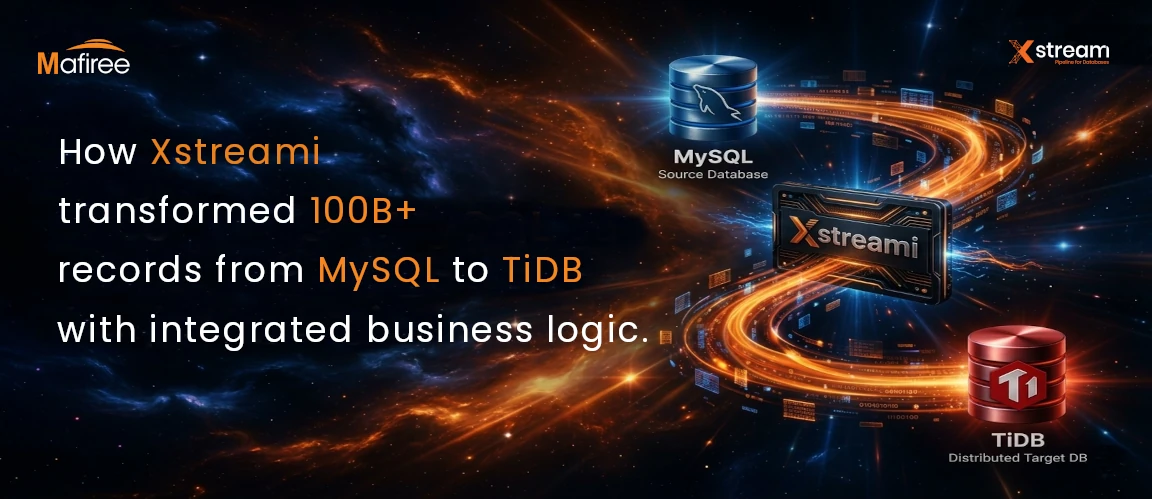
MySQL to TiDB Migration: Streaming 100 Billion Records in Real Time

A payment service needed real-time streaming AND historical data transformation across 40 MySQL tables into one TiDB table. Xstreami delivered 100 billion records migrated with 0% data loss, complex business logic — zero lines of code written.

  760 views
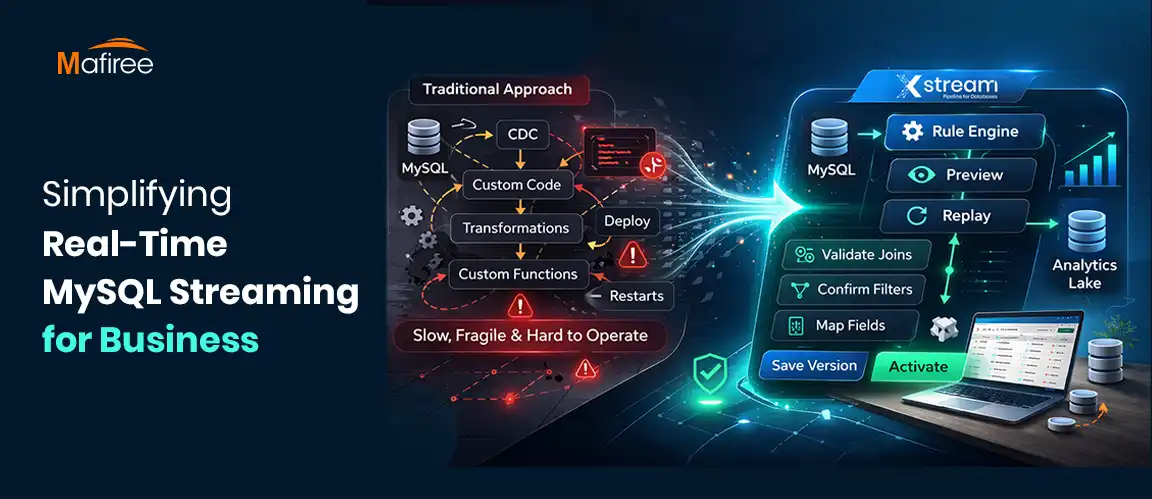
How Xstreami Makes Real-Time MySQL CDC Operationally Simple for Business Use-Cases

This blog explains how Xstreami helps teams operationalise real-time MySQL CDC or streaming by simplifying business rule management, preview, deployment and replay—without sacrificing technical depth or reliability.

  557 views
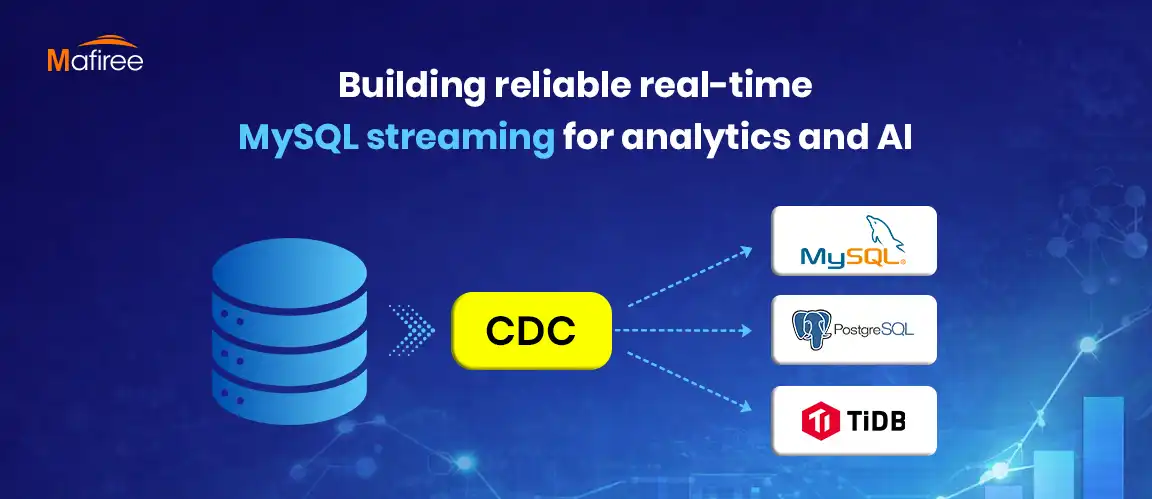
Building reliable real-time MySQL streaming for analytics and AI

This blog explains why MySQL real-time streaming has become essential for modern analytics and AI systems, and how CDC-based architectures enable reliable, observable and scalable data pipelines for fast, data-driven decisions.

  818 views

Subscribe for email updates

Get in touch with us

Highlights

More than 6000 Servers Monitored

Happy Clients

Certified DBAs

24 x 7 x 365 Support

PCI

Database Services

MySQL MongoDB PostgreSQL SQL Server Aerospike Clickhouse TiDB MariaDB Columnstore

Quick Links

Careers Blog Contact Privacy Policy Disclaimer Policy

Contacts

Linkedin Mafiree Facebook Mafiree Twitter Mafiree

Nagercoil Office

Miru IT Park, Vallankumaranvillai,

Nagercoil, Tamilnadu - 629 002.

Bangalore Office

Unit 303, Vanguard Rise,

5th Main, Konena Agrahara,

Old Airport Road, Bangalore - 560 017.

Call: +91 6383016411

Email: sales@mafiree.com

Copyright © - All Rights Reserved - Mafiree