Mafiree logo
  • About
  • Services
  • Blogs
  • Careers
  • Products
    • orbit logo Orbit
    • streamer logo Xstreami
  • Contact
Schedule a Call
Menu
  • About
  • Services
  • Blogs
  • Careers
  • Products
    • orbit logo Orbit
    • streamer logo Xstreami
  • Contact
  • Schedule a Call
Database
Database Managed Database Services
MySQL MySQL
MySQL Consulting
MySQL Migration Services
MySQL Optimization & Query Tuning
MySQL Database Administration
MySQL Backup & Recovery
MySQL Security & Maintenance
MySQL Cloud Services (AWS RDS, Aurora, Google Cloud SQL, Azure)
MySQL for Ecommerce
MySQL High Availability & Replication
MongoDB MongoDB
MongoDB Consulting
MongoDB Migration Services
MongoDB Optimization & Query Tuning
MongoDB Database Administration
MongoDB Backup & Recovery
MongoDB Security & Maintenance
MongoDB Cloud (Atlas)
MongoDB Solutions by Industry
MongoDB High Availability & Replication
PostgreSQL PostgreSQL
PostgreSQL Consulting
PostgreSQL Migration & Upgrades
Performance Tuning & Query Optimization
PostgreSQL Administration & Managed Services
High Availability, Clustering & Replication
PostgreSQL Backup, Recovery & Disaster Planning
PostgreSQL Security, Compliance & Auditing
PostgreSQL for Analytics & Data Warehousing
PostgreSQL on Cloud & Containers
PostgreSQL Extensions & Open-Source Integrations
PostgreSQL for Every Industry
SQL Server MSSQL
MSSQL Consulting
MSSQL Migration Services
MSSQL Optimization & Query Tuning Services
MSSQL Database Administration Services
MSSQL Backup & Recovery Services
MSSQL High Availability & Replication Services
MSSQL Security & Compliance Services
MSSQL Performance Monitoring & Health Checks
MSSQL Solutions by Industry
Aerospike Aerospike
Aerospike Consulting
Aerospike Migration Services
Aerospike Performance Optimization & Tuning
Aerospike Backup & Recovery
Aerospike High Availability
Aerospike Cloud & Hybrid Deployments
Aerospike for Real-Time Applications (AdTech, FinTech, Retail, IoT)
Clickhouse Clickhouse
ClickHouse Consulting
ClickHouse Migration Services
ClickHouse Optimization & Query Tuning
ClickHouse Database Administration
ClickHouse Backup & Recovery
ClickHouse Security & Maintenance
ClickHouse Cloud Services (ClickHouse Cloud, AWS, GCP, Azure)
ClickHouse Solutions by Industry
ClickHouse High Availability & Replication
TiDB TiDB
TiDB Consulting
TiDB Administration & Maintenance
TiDB Security and Privacy Maintenance
TiDB Performance & Query Optimization
TiDB Migration Services
TiDB Backup & Disaster Recovery
TiDB High Availability Solutions
TiDB Solutions by Industry
TiDB Cloud Services
ScyllaDB ScyllaDB
ScyllaDB Consulting
ScyllaDB Administration & Maintenance
ScyllaDB Security and Privacy Maintenance
ScyllaDB Performance & Query Optimization
ScyllaDB Migration Services
ScyllaDB Backup & Disaster Recovery
ScyllaDB High Availability Solutions
ScyllaDB Solutions by Industry
ScyllaDB Cloud Services
DevOps
DevOps DevOps Services
Version Control Version Control
Kubernetes Kubernetes
Infrastructure Infrastructure Management
Web Servers Web Servers
Networking
Networking Networking Services
Basic Basic
Advanced Advanced
MySQL MySQL
MongoDB MongoDB
PostgreSQL PostgreSQL
MSSQL MSSQL
Aerospike Aerospike
Clickhouse Clickhouse
TiDB TiDB
ScyllaDB ScyllaDB
Version Control Version Control
Kubernetes Kubernetes
Infrastructure Infrastructure Management
Web Servers Web Servers
Basic Basic
Advanced Advanced
MySQL Consulting
MySQL Migration Services
MySQL Optimization & Query Tuning
MySQL Database Administration
MySQL Backup & Recovery
MySQL Security & Maintenance
MySQL Cloud Services (AWS RDS, Aurora, Google Cloud SQL, Azure)
MySQL for Ecommerce
MySQL High Availability & Replication
MongoDB Consulting
MongoDB Migration Services
MongoDB Optimization & Query Tuning
MongoDB Database Administration
MongoDB Backup & Recovery
MongoDB Security & Maintenance
MongoDB Cloud (Atlas)
MongoDB Solutions by Industry
MongoDB High Availability & Replication
PostgreSQL Consulting
PostgreSQL Migration & Upgrades
Performance Tuning & Query Optimization
PostgreSQL Administration & Managed Services
High Availability, Clustering & Replication
PostgreSQL Backup, Recovery & Disaster Planning
PostgreSQL Security, Compliance & Auditing
PostgreSQL for Analytics & Data Warehousing
PostgreSQL on Cloud & Containers
PostgreSQL Extensions & Open-Source Integrations
PostgreSQL for Every Industry
MSSQL Consulting
MSSQL Migration Services
MSSQL Optimization & Query Tuning Services
MSSQL Database Administration Services
MSSQL Backup & Recovery Services
MSSQL High Availability & Replication Services
MSSQL Security & Compliance Services
MSSQL Performance Monitoring & Health Checks
MSSQL Solutions by Industry
Aerospike Consulting
Aerospike Migration Services
Aerospike Performance Optimization & Tuning
Aerospike Backup & Recovery
Aerospike High Availability
Aerospike Cloud & Hybrid Deployments
Aerospike for Real-Time Applications (AdTech, FinTech, Retail, IoT)
ClickHouse Consulting
ClickHouse Migration Services
ClickHouse Optimization & Query Tuning
ClickHouse Database Administration
ClickHouse Backup & Recovery
ClickHouse Security & Maintenance
ClickHouse Cloud Services (ClickHouse Cloud, AWS, GCP, Azure)
ClickHouse Solutions by Industry
ClickHouse High Availability & Replication
TiDB Consulting
TiDB Administration & Maintenance
TiDB Security and Privacy Maintenance
TiDB Performance & Query Optimization
TiDB Migration Services
TiDB Backup & Disaster Recovery
TiDB High Availability Solutions
TiDB Solutions by Industry
TiDB Cloud Services
ScyllaDB Consulting
ScyllaDB Administration & Maintenance
ScyllaDB Security and Privacy Maintenance
ScyllaDB Performance & Query Optimization
ScyllaDB Migration Services
ScyllaDB Backup & Disaster Recovery
ScyllaDB High Availability Solutions
ScyllaDB Solutions by Industry
ScyllaDB Cloud Services
  1. Home
  2. > Blogs
  3. > MongoDB
  4. > 6 Interesting Features In MongoDB 6.0

6 Interesting Features In MongoDB 6.0

Upgrade to MongoDB 6.0 for improved index management, error handling, powerful aggregation, replicaset enhancements, time series collection improvements, and embedded field exclusion. Experience efficient database management.

Thivakar October 29, 2026

Table of Contents

  • Introduction
  • Topics Covered
  • 1.Changes and Improvements Related With Indexes
  • CollMod
  • Drop all Indexes
  • New operators in partial index
  • 2. Syntax Error Handling
  • 3. Aggregation
  • 4. Replicaset Changes
  • 5. Time Series Collection Changes
  • 6. Exclude Embedded Field on serverStatus
  • Summary

Subscribe for email updates

RSS feed
Summarize with AI: ChatGPT Google AI Perplexity Claude Grok

Introduction

In this blog, we explore the remarkable enhancements introduced in MongoDB 6.0. We will have a look into the key updates related to indexes, syntax error handling, powerful aggregation capabilities, replicaset improvements, time series collection changes, and the ability to exclude embedded fields. Let’s explore the potential of MongoDB 6.0 and revolutionize your database management experience.

In this blog we are going to see 6 main features in Mongodb 6.0.

Note: These features are specifically after 5.0 versions.


Topics Covered

Below are the 6 interesting features that we have covered in this blog.

  1. Changes and Improvements Related With Indexes
  2. Syntax Error Handling
  3. Aggregation
  4. Replicaset Changes
  5. Time Series Collection Changes
  6. Exclude Embedded Field on serverStatus

1.Changes and Improvements Related With Indexes


CollMod

  • Introducing new features in the ‘collMod’ function, a powerful command that allows you to modify existing indexes without the need for recreation. With ‘collMod,’ you can easily make indexes unique, hidden, and even add Time-to-Live (TTL) settings.
  • To make the existing index unique, you need to first prevent any incoming duplicate entries. You can achieve this by using the following command, which will stop duplicate entries on the ‘createdAt’ field associated with the index named ‘createdAt_1’.
db.runCommand({collMod:"collections_name",index:{name: "createdAt_1",prepareUnique: true}})


  • Then make the existing index ‘createdAt_1’ unique with the below command.
db.runCommand({collMod:"collections_name",index:{name: "createdAt_1",unique: true}})


  • By using the ‘collMod’ function, you can modify an existing index to be hidden, making it invisible to regular queries.

db.runCommand({collMod:"collections_name",index:{name: "createdAt_1", hidden: true}})


  • By using the ‘collMod’ function, enabling TTL on an existing index becomes effortless.

db.runCommand({collMod:"collections_name",index:{name: "createdAt_1", expireAfterSeconds: 30000}})


Drop all Indexes
 

  • Now you can drop all the indexes from the collection with a single command, except for the primary index (‘_id’) with the below command.

db.collections_name.dropIndexes()


New operators in partial index
 

  • Introducing new operators in the partial index: $in and $or. The $in operator indexes only the documents where the mentioned field (id1) has values of 1 and 2. On the other hand, the $or operator indexes only the documents where the mentioned field (id1) has a value of 1 or 2.

db.collections_name.createIndex({"id1":1},{partialFilterExpression:{id1: {$in: [1,2]}}})

db.collections_name.createIndex({"id1":1},{partialFilterExpression:{$or: [{id1:1},{id1:2}]}})


2. Syntax Error Handling
 

  • When you make a syntax error, there is no need to search for the position where you made it. In the new version, it will display the line and position at which you made the error.

Uncaught:
SyntaxError: Unexpected token (1:26)

> 1 | db.collections_name.find({)
| ^
2 |


3. Aggregation

  • Introducing new stages in the aggregation:

$documents, $densify, $fill, and $shardedDataDistribution.


  • Introducing new operators in the aggregation:

$bottom, $bottomN, $firstN, $lastN, $linearfill, $locf, $maxN, $minN, $sortArray, $top, $topN, $tsIncrement and $tsSecond.

Note: Shall provide a more detailed explanation in my upcoming blogs.


4. Replicaset Changes

  • Introducing the ‘initialSyncMethod’ which determines whether the initial sync method is logical or file-based. Please note that this option is only available in MongoDB Enterprise server.
  • Support for multiple arbiters in a replica set is disabled by default. To enable this feature, start each node with the ‘allowMultipleArbiters’ parameter.


5. Time Series Collection Changes

  • Now, you can perform updates and deletes on time series collections with some limitations.
  • You can only match metafield data values for both update and delete operations. Additionally, you can only modify the value of the metaField field during an update.
  • The update and delete commands should not limit the number of documents. Instead, you can utilize the ‘updateMany’ and ‘deleteMany’ commands.
  • Introducing Column Compression, which reduces the size of data on disk when compressed with zstd. Additionally, it significantly reduces the space used in the WiredTiger cache.
  • Now you can add the additional secondary indexes on the time series collection.


6. Exclude Embedded Field on serverStatus


  • Now you can exclude any of the embedded fields from the output of the ‘db.serverStatus()’ command. For example, the ‘histograms’ embedded field has been excluded below.

db.runCommand( { serverStatus: 1, metrics: { query: { multiPlanner: { histograms: false } } } } )


Summary:

MongoDB 6.0 brings a host of significant improvements to streamline your database management. With the introduction of the ‘collMod’ function, modifying indexes becomes more flexible and convenient. Enhanced syntax error handling ensures smoother troubleshooting. Unlock advanced aggregation stages and operators to elevate your data analysis capabilities. Benefit from replicaset changes that offer improved syncing methods. Explore new possibilities in time series collection operations and effortlessly exclude embedded fields in serverStatus output. Upgrade to MongoDB 6.0 and embrace a more efficient and powerful approach to data management.


FAQ

MongoDB 6.0 introduced several improvements, including enhanced index management through collMod, improved syntax-error reporting, new aggregation stages and operators, replica-set enhancements, expanded time-series collection capabilities, and the ability to exclude embedded fields from serverStatus output.
MongoDB 6.0 enhanced the collMod command so existing indexes can be modified without recreating them. This includes making indexes unique, hiding indexes, and adding TTL settings. MongoDB 6.0 also introduced additional operators for partial indexes and allows all indexes other than the _id index to be dropped using dropIndexes().
MongoDB 6.0 introduced new aggregation stages including $documents, $densify, $fill, and $shardedDataDistribution. It also added operators such as $bottom, $bottomN, $firstN, $lastN, $linearFill, $locf, $maxN, $minN, $sortArray, $top, $topN, $tsIncrement, and $tsSecond. These additions provide more capabilities for analytics, data filling, ranking, and time-series processing.
MongoDB 6.0 expanded time-series functionality by allowing certain update and delete operations on time-series collections. It also introduced column compression for time-series data, additional secondary indexes, and improvements for managing time-series workloads. These changes can help reduce storage requirements and improve the flexibility of time-series data management.
MongoDB 6.0 introduced the initialSyncMethod option, which allows the initial synchronization method to be selected between logical and file-based approaches in supported environments. It also allows administrators to exclude selected embedded fields from serverStatus output, making monitoring output more focused and potentially easier to consume.

Leave a Comment

Related Blogs

MongoDB Atlas Vector Search Tutorial: Build Semantic Search for Free

Build semantic search on MongoDB Atlas without paying for an embedding API. This tutorial shows two free routes: automatic embeddings with Voyage AI models (autoEmbed), where Atlas creates the vectors for you, and open-source sentence-transformers embeddings that you generate yourself. You will load sample data, create a vector index, query with $vectorSearch, add filters, and learn how to troubleshoot common problems, with an optional section for OpenAI embeddings.

  201 views
MongoDB Use Cases That Actually Need Expert Consulting Support

Not every MongoDB project needs a consultant—but complex workloads often do. This guide covers five MongoDB use cases where expert support can make the difference: schema design, large-scale migration, performance optimization, high availability and disaster recovery, and security and compliance.

  312 views
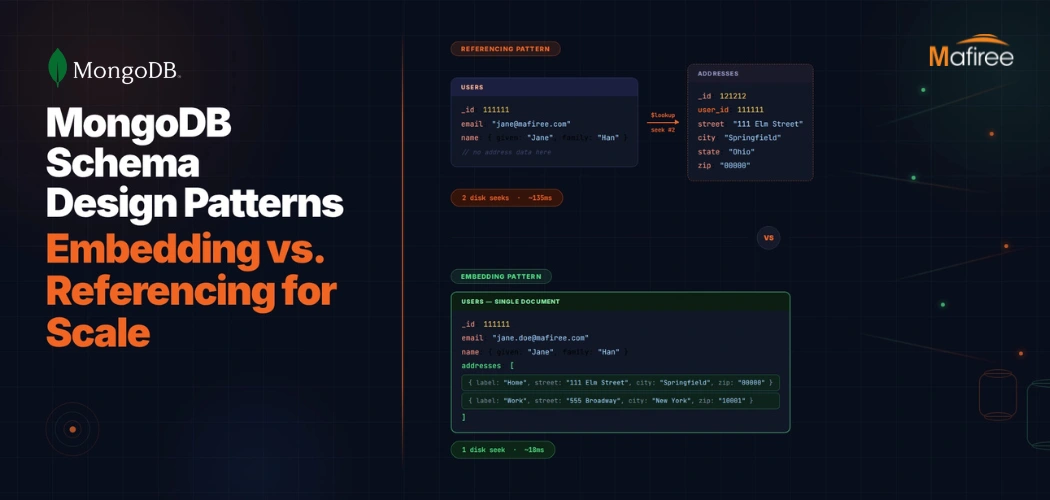
MongoDB Schema Design Patterns: Embedding vs. Referencing for Scale

Scale your MongoDB database by choosing the right relationship model. This guide breaks down the transition from traditional Referencing to high-performance Embedding and hybrid patterns like Extended References. Learn how to optimize your read/write paths and when to engage Mafiree’s performance tuning experts for enterprise-grade optimization.

  2970 views
MongoDB Query Optimization: How Mafiree Reduced E-Commerce Latency by 73%

Slow MongoDB queries silently erode user experience and revenue. This case study walks through how Mafiree’s MongoDB consulting team audited and optimized the query layer of a high-traffic e-commerce platform in India, reducing average API response times from 340ms to 92ms—a 73% improvement. It covers the diagnostic process using explain plans and profiler data, the indexing strategy overhaul, aggregation pipeline refactoring, and the monitoring framework that keeps performance on track.

  1806 views
MongoDB Transactions: A Comprehensive Guide to ACID Compliance

MongoDB ensures data consistency with single-document atomic operations and multi-document transactions. This guide explains how to implement transactions, their limitations, performance impacts, and best practices for production environments. It also highlights when to use distributed transactions and how expert consulting can help optimize performance.

  6775 views
Let MongoDB Clean Up After Itself: A Complete Guide to TTL Indexes

Tired of bloated log collections and messy data? TTL indexes in MongoDB automate your cleanup no cron jobs, no scripts. Learn how to set up, monitor, and optimize TTL for cleaner, faster, and self-maintaining databases.

  7947 views
Top 10 MongoDB Operators Every Developer Should Know (With Examples)

Unlock MongoDB’s full potential! Discover the most powerful MongoDB query operators to supercharge your queries with practical examples every developer can use. #MongoDB #DeveloperTips

  4747 views
Reclaiming MongoDB Storage Space: A Journey to 50% Space Reduction

Efficiently Reclaim Disk Space in MongoDB: Strategies and Solutions for Optimal Performance.

  4212 views
Don't Let Hackers In: How to Secure and Harden Your MongoDB Database

Learn how to protect your MongoDB database with robust security practices, including user authentication, encryption, IP whitelisting, and input validation. Ensure your data remains safe and accessible in today's evolving threat landscape.

  5011 views
Seamless Data Transition: Exploring MongoDB Cluster To Cluster Sync

Achieve real-time data consistency with MongoDB Cluster-to-Cluster Sync. Discover how MongoSync enables seamless data synchronization for disaster recovery, global availability, and smooth migrations.

  8668 views
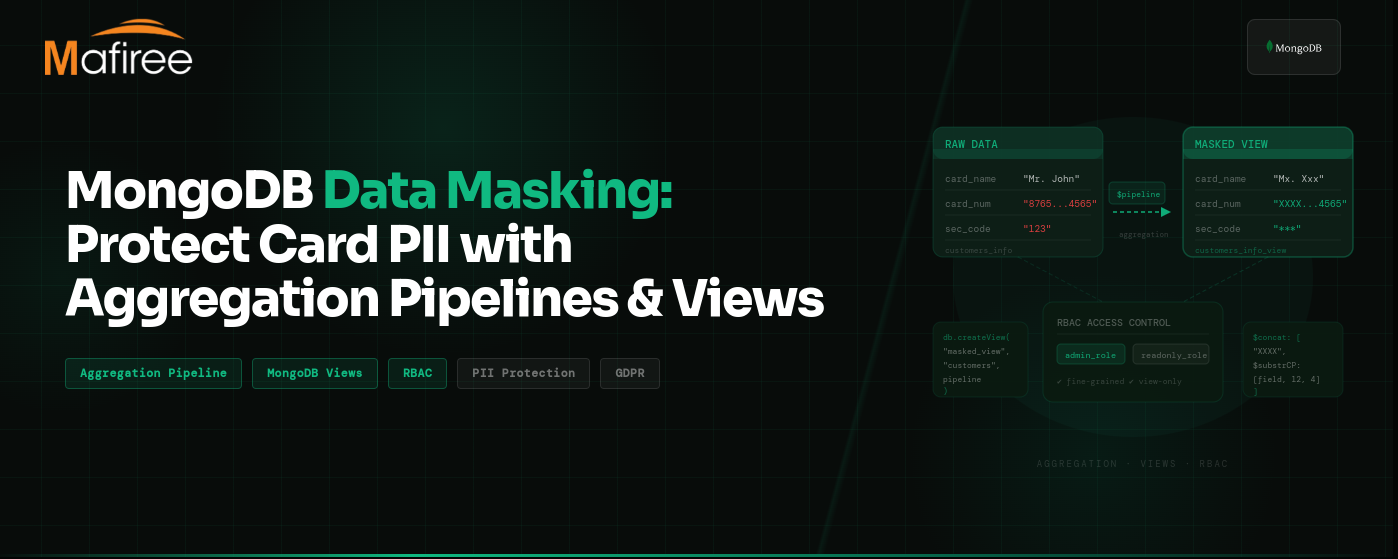
MongoDB Data Masking: Protect Card PII with Aggregation Pipelines and Views

MongoDB data masking helps organizations protect sensitive data like card numbers, names, and security codes while keeping data queryable. This guide explains how to implement masking using aggregation pipelines and RBAC-secured views, especially for environments where MongoDB field-level or queryable encryption is not available. Learn practical techniques, best practices, and real-world implementation steps to achieve MongoDB GDPR compliance.MongoDB data masking helps organizations protect sensitive data like card numbers, names, and security codes while keeping data queryable. This guide explains how to implement masking using aggregation pipelines and RBAC-secured views, especially for environments where MongoDB field-level or queryable encryption is not available. Learn practical techniques, best practices, and real-world implementation steps to achieve MongoDB GDPR compliance.

  1876 views
A Practical Guide to MongoDB Schema Validation

MongoDB schema validation helps maintain data consistency while preserving MongoDB’s flexible document model. It allows you to define rules for document structure, required fields, data types, and permitted values using JSON Schema. It also demonstrates how MongoDB rejects documents that fail the defined rules, helping applications prevent unintended schema changes and invalid data.

  1094 views
Protecting Sensitive Data: Mastering Queryable Encryption in MongoDB

Blog post showing how queryable encryption is being used to protect sensitive data.

  2709 views
Whats new in MongoDB 4.2

The wait is over for MongoDB 4.2. In this article, we will be discussing all the new features of MongoDB 4.2.

  3134 views
Why Use MongoDB for Modern Applications

Next generation databases must address some of the points such as being non-relational,highly available,open source and horizontally scalable. NoSQL databases has much increased features when it comes to non-structural data. In this article, we will discuss basics of NoSQL databases and why you need.

  1855 views

Subscribe for email updates

RSS feed
Get in touch with us

Highlights

More than 6000 Servers Monitored

Happy Clients

Certified DBAs

24 x 7 x 365 Support

PCI

Database Services

MySQL MongoDB PostgreSQL SQL Server Aerospike Clickhouse TiDB ScyllaDB

Quick Links

Careers Blog Contact Privacy Policy Disclaimer Policy

Contacts

Linkedin Mafiree Facebook Mafiree Twitter Mafiree

Nagercoil Office

Miru IT Park, Vallankumaranvillai,

Nagercoil, Tamilnadu - 629 002.

Bangalore Office

Unit 303, Vanguard Rise,

5th Main, Konena Agrahara,

Old Airport Road, Bangalore - 560 017.

Call: +91 6383016411

Email: sales@mafiree.com


Copyright © - All Rights Reserved - Mafiree