 Orbit
Orbit
 Xstreami

- About
- Services
- Blogs
- Careers
- Products
- Contact Schedule a Call
This blog explains the purpose and importance of software deployment environments in modern IT and DevOps workflows. It covers the complete software deployment environments pipeline from Development (DEV) to Quality Assurance (QA), User Acceptance Testing (UAT), and Production (PROD). Readers will learn how each environment helps improve software quality, reduce deployment risks, protect user data, and ensure stable releases. The article highlights the differences between Staging & UAT and how software deployment environments in DevOps, provides a side-by-side comparison table, and answers common questions about deployment strategies in IT companies.We also provide managed database consulting services to ensure your application infrastructure remains secure, scalable, and highly available throughout every deployment stage
Godwin Udayakumar M August 11, 2026

Modern software applications are updated continuously. Without properly separated deployment environments, even a small bug could affect live users, expose sensitive data, or break critical business operations.
Software deployment environments provide controlled stages where developers, testers, and business stakeholders can validate applications before releasing them to customers.
In modern DevOps and CI/CD workflows, deployment environments play a crucial role in maintaining software quality and operational stability. They help organizations reduce deployment failures, detect bugs earlier in the development lifecycle, improve security compliance, protect production systems, and deliver faster, safer releases.
Whether it is a startup deploying weekly updates or an enterprise managing mission-critical applications, environment separation is essential for stable software delivery.

Every piece of software you use today passes through a series of carefully separated environments before it reaches users. These are not bureaucratic overhead — they are the invisible scaffolding that lets teams move fast without breaking things for real users.
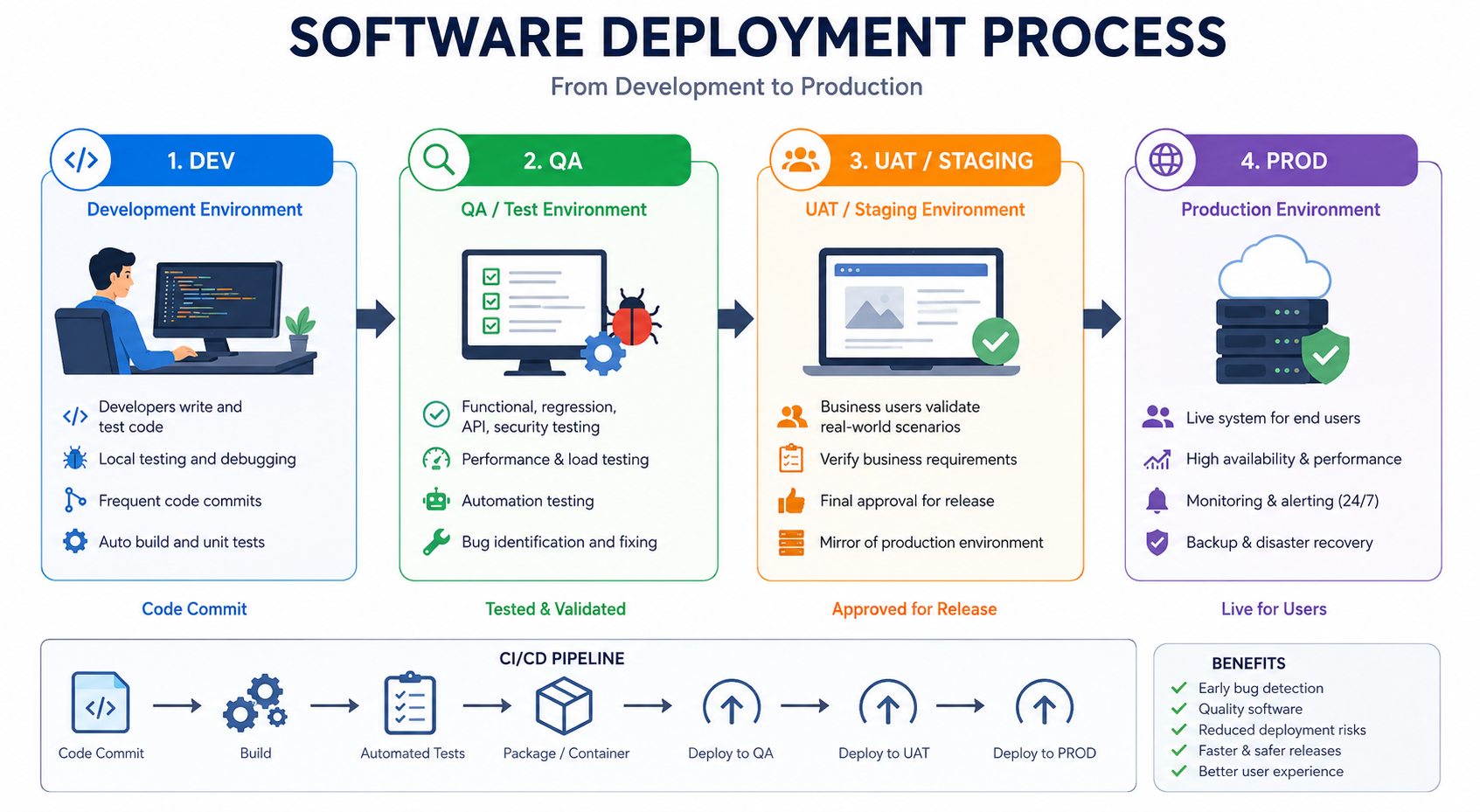
The deployment pipeline follows a clear path:
DEV → QA → UAT → PROD
For container-based deployments, our Kubernetes orchestration services can help you scale efficiently.
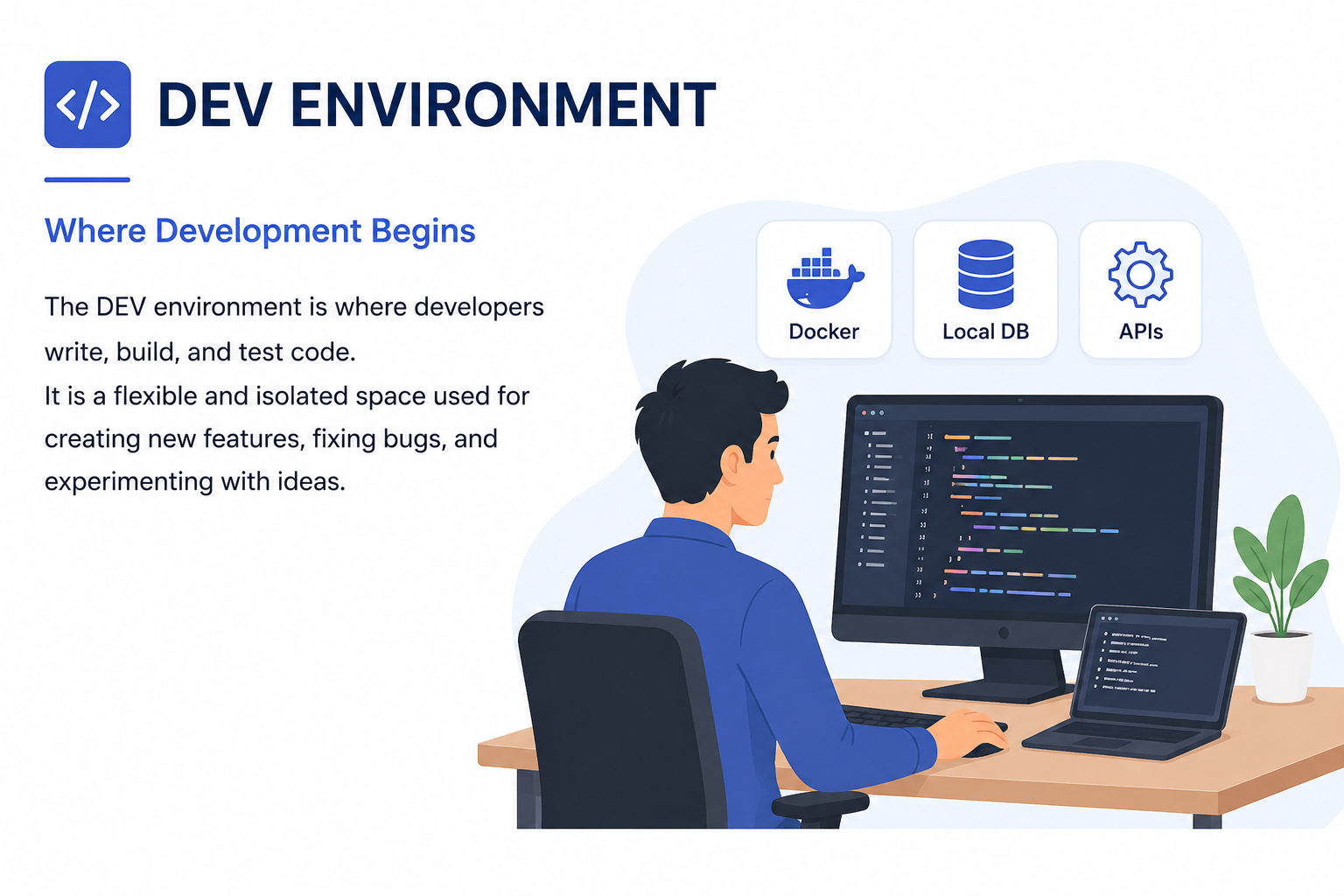
The Development Environment (DEV) is the first stage of the software lifecycle where developers write, modify, and test code during active development.
This environment is highly dynamic because developers continuously add new features, fix bugs, and test integrations. Changes happen rapidly, and stability is not the main priority. New functionality is introduced, existing code is refined, and integrations are tested regularly. As a result, stability is not the primary objective in the DEV environment. Instead, the focus is on rapid development, experimentation, and innovation.
To support these activities, developers typically run applications locally using tools such as Docker containers, local databases, Kubernetes Minikube, virtual machines, and local API servers. These technologies allow teams to replicate application behavior in an isolated setting while maintaining the flexibility needed for development.
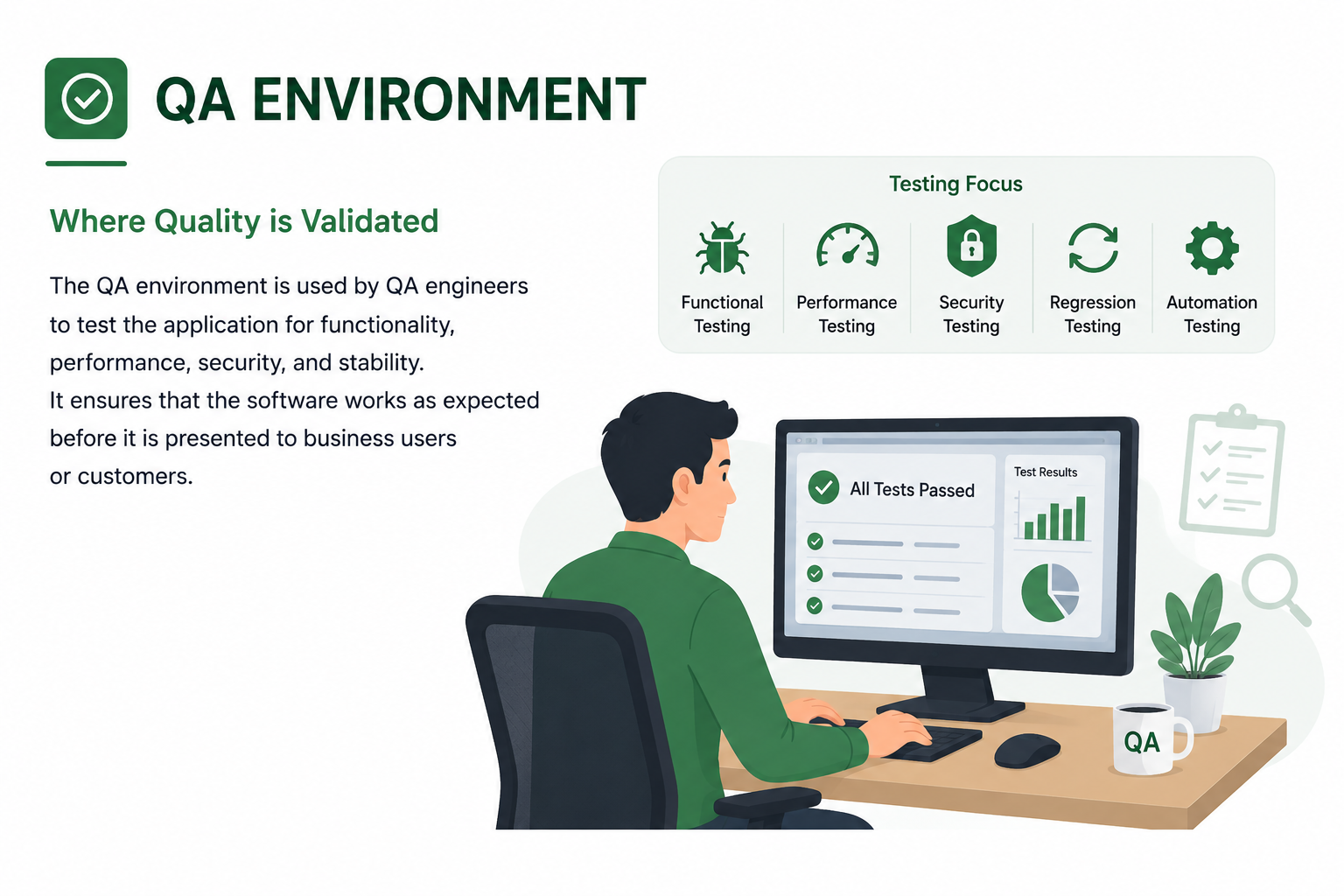
The QA (Quality Assurance) Environment is designed to verify that software behaves correctly before business users or customers interact with it.
Unlike DEV, QA environments focus on testing stability and functionality rather than development speed. Here, QA engineers evaluate the application under various conditions to confirm that new features work as intended and that existing functionality remains unaffected by recent changes.
Testing activities in the QA environment typically include functional testing, regression testing, API testing, security testing, performance testing, and automation testing. These tests help ensure that the application behaves consistently and meets both technical and business requirements.
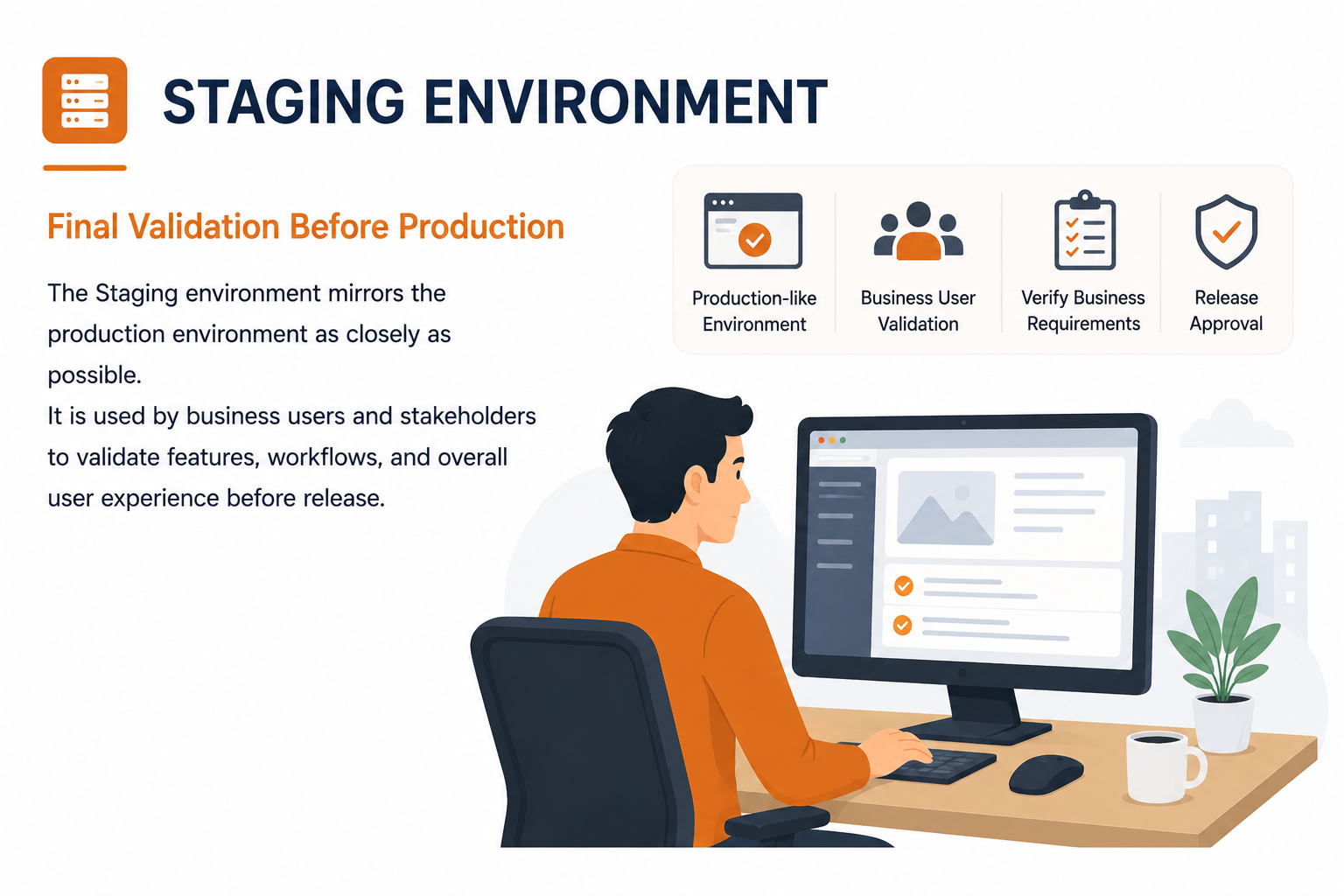
The UAT (User Acceptance Testing) or Staging Environment acts as the final checkpoint before software reaches production.
To provide accurate validation, the staging environment is typically configured to replicate production as closely as possible, including application configurations, database structures, load balancers, security policies, and network settings. This similarity allows teams to identify potential issues that may not have been visible in earlier testing environments.
Unlike the QA environment, which focuses primarily on technical testing and defect detection, UAT is centered on validating business requirements and user workflows. Business stakeholders, product owners, and end users assess whether the application behaves as expected and supports real operational processes. Common validation scenarios include order processing, user registration, payment workflows, report generation, and approval processes.
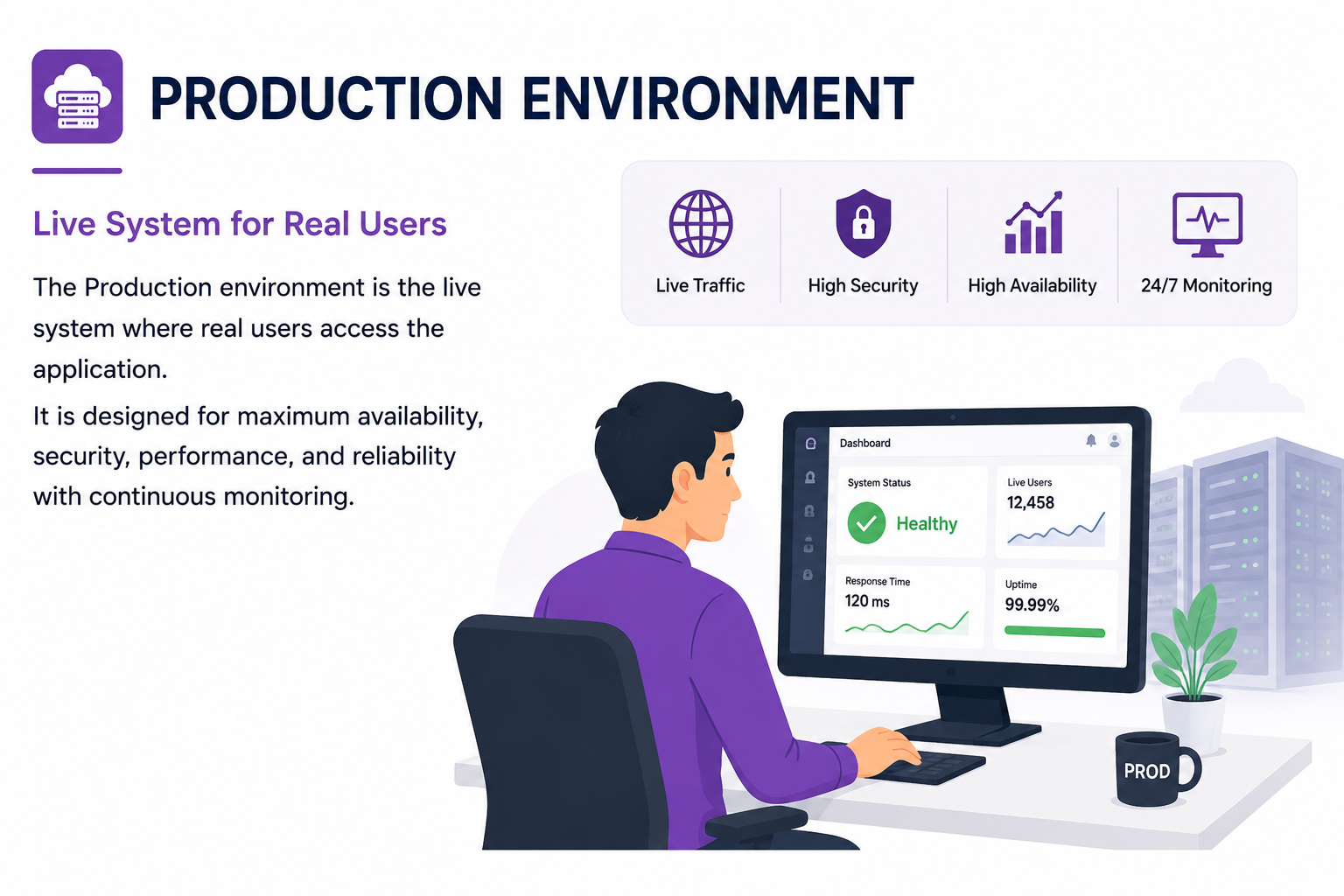
The Production Environment (PROD) is the live environment where real users access the application.
Unlike the previous stages of the software lifecycle, production systems must prioritize reliability, security, performance, and availability because any issue can directly impact customers and business processes.
To support business-critical workloads, production environments are designed with high availability, strong security controls, continuous monitoring, fast application performance, and disaster recovery capabilities. The infrastructure typically includes auto-scaling resources, load balancers, backup systems, monitoring dashboards, security monitoring solutions, and incident response mechanisms to ensure the application remains stable and accessible under varying levels of demand.
Because production systems serve real users, deployments are carefully planned and executed to minimize risk and downtime. Organizations commonly use deployment strategies such as Blue-Green Deployments, Canary Releases, Rolling Updates, and Feature Flags to introduce changes gradually while maintaining service continuity.
Production stability is critical because even a small failure can have significant consequences. Service disruptions may lead to revenue loss, customer dissatisfaction, reputation damage, security incidents, or compliance violations. For this reason, production deployments are typically governed by strict change management processes that include approvals, rollback plans, and extensive monitoring to ensure any issues can be identified and addressed quickly.
Mafiree has an organized deployment structure that our organization follows, as outlined below.
Developers create and test the feature locally.
QA engineers test payment workflows, API responses, and security validation.
Business teams verify whether the checkout process works correctly for customers.
The feature is released to live users using a controlled deployment strategy.
This staged approach ensures problems are identified before customers experience them.
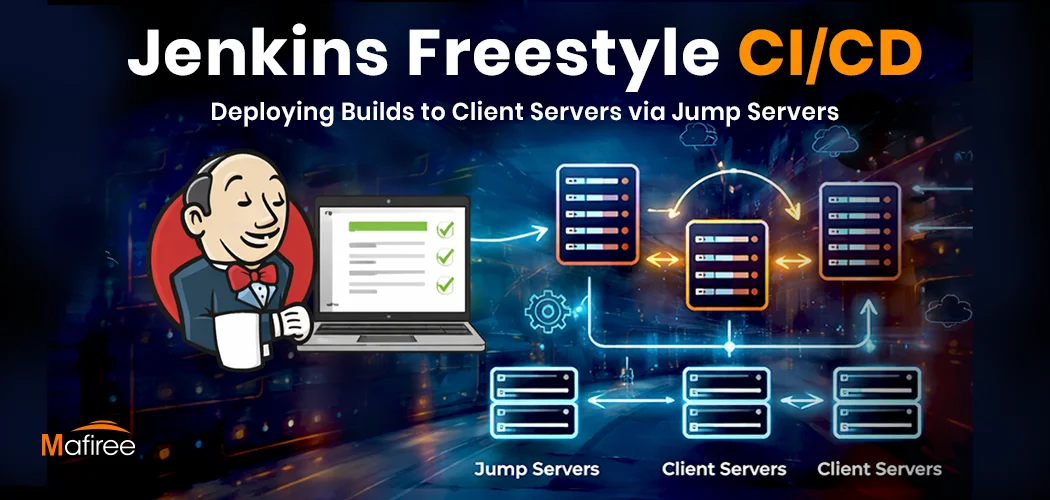
For Jenkins Deployment, our Jenkins Freestyle Deployment will help you deploy services efficiently

Each environment should follow strict security controls.
Organizations often face challenges such as:
DevOps practices and automation help solve these issues.
Focus: Technical validation
Used by: Developers and testers
Purpose: Bug detection, deployment verification
Tests: Smoke tests, release rehearsal
Focus: Business validation
Used by: Clients, product owners, business analysts
Purpose: Ensure business requirements are met
Tests: Real-world scenarios
Once UAT is approved, the release is cleared for production.
| Attribute | DEV | SIT | UAT | PROD |
| Stability | Low | Moderate | High | Highest |
| Data Type | Synthetic | Anonymised | Masked real data | Live data |
| Users | Developers | QA Engineers | Business Users | End Users |
| Deployment | Every commit | Scheduled | Per release | Controlled |
| Risk | High | Moderate | Low | Zero |
| Monitoring | Minimal | Minimal | High | 24/7 |
| Configuration | Flexible | Test-focused | Near-production | Strict |

Software deployment environments are essential for delivering reliable and secure applications.
By separating development, testing, validation, and production systems, organizations can:
At Mafiree we provide a well-structured deployment pipeline that enables teams to innovate faster while ensuring stable production systems.
As DevOps and cloud-native technologies continue to evolve, properly managed environments remain one of the most important foundations of modern software engineering.
Production is the live system used by real customers. Failures here have serious consequences, including financial loss and reputational damage.
More than 6000 Servers Monitored
Happy Clients
Certified DBAs
24 x 7 x 365 Support



Miru IT Park, Vallankumaranvillai,
Nagercoil, Tamilnadu - 629 002.
Unit 303, Vanguard Rise,
5th Main, Konena Agrahara,
Old Airport Road, Bangalore - 560 017.
Call: +91 6383016411
Email: sales@mafiree.com